
When I take a new seat, my first 100 days follow the same sequence every time: weeks 0–2 cutting the data before I meet the opinions, weeks 2–6 building the EBITDA bridge and locking the number, weeks 6–10 auditing the team and setting the locks, and weeks 10–14 writing the plan the board actually signs. I have run this sequence taking over companies from a few hundred million to roughly $2B in revenue, and today I run a $1.5B PE-backed industrial company where it was the first thing I did. The sequence is boring. That is the point. The first 100 days is not the time for brilliance. It is the time for arithmetic.
The stakes are specific. Around 70% of PE-backed CEOs are replaced, mostly in months 18 to 24, and in nearly every case the seeds were planted in the first quarter — a plan that was never really agreed, a team gap everyone saw and nobody named, a board that formed its picture of the business from a different set of numbers than the CEO was using. The first 100 days is when you either close those gaps or schedule your own month-18 conversation. Here is exactly how I spend them.
Weeks 0–2: the data cut before the opinions
Before I sit down with a single executive for a real conversation, I pull the data. Three years of revenue and margin by customer, by product line, by region — down to the SKU where the systems allow it. Then I run the 80/20 cut. The pattern is nearly universal: the top quartile of customers and products generates somewhere between 105% and 150% of total profit, which means the bottom half of the business is consuming profit that the top half earned. At one company, illustratively, 9% of the SKUs produced 117% of the operating profit, and the sales team’s incentive plan was paying commissions to grow the other 91%.
The reason for data-before-opinions is not that opinions do not matter. It is that opinions arrive pre-loaded. Every executive who walks into my office in week one is carrying a story polished over years — about why their division underperforms, why that customer is strategic, why the plant cannot close. If I hear the stories first, I evaluate the data through the stories. If I see the data first, I evaluate the stories through the data. Same inputs, opposite conclusions. Two weeks of quiet spreadsheet work buys me a lie detector I will use for the rest of the hold.
The questions I ask every executive in the first week
While the data is being cut, I do meet the team — briefly, one on one, with the same short list of questions for everyone. Where does this business actually make its money? What would you fix first if you had my job? What has been tried before and why did it fail? Who on this team would you keep if you could only keep three? And what is the thing everyone here knows but nobody says in meetings? I write the answers down verbatim.
The answers matter less individually than in the overlay. When six executives name the same unspoken problem, I have found the real agenda. When the CFO’s account of where the money is made disagrees with the 80/20 cut, I have found either a data problem or a self-awareness problem, and both are worth knowing in week one. The last question — what does everyone know but nobody say — has never once failed to produce something important. People are usually honest with a new CEO for about three weeks. I try not to waste the window.
Weeks 2–6: the bridge and the number
By week two I want the number: the exit EBITDA the sponsor actually needs, in writing, with a date. Not the budget, not the aspiration on slide four — the number the fund model requires. Illustratively: we bought at $45M of EBITDA, the model needs $80M in year five with no multiple expansion assumed, because multiple expansion is dead and any plan that quietly relies on it is a plan to disappoint everyone in year four. Getting this number on paper, signed by me and the board, is what I call the Board Lock, and I will not proceed past week six without it.
Then I build the bridge from here to there across five levers: price, mix, share, M&A, and cost. Each lever gets a quantified target, an owner, and a first milestone inside 90 days. The 80/20 cut from weeks 0–2 feeds directly into this — price and mix moves come straight out of knowing which quartile earns the profit. I also check the Right-to-Grow ratio: material margin divided by employee cost, where roughly 2.0 is the line. Above it, the business has earned the right to invest in growth. Below it, growth spends money the operation has not earned yet, and the bridge has to start with margin, not volume. One page. Five rows. That page becomes the constitution of the hold.
Weeks 6–10: the team audit and the locks
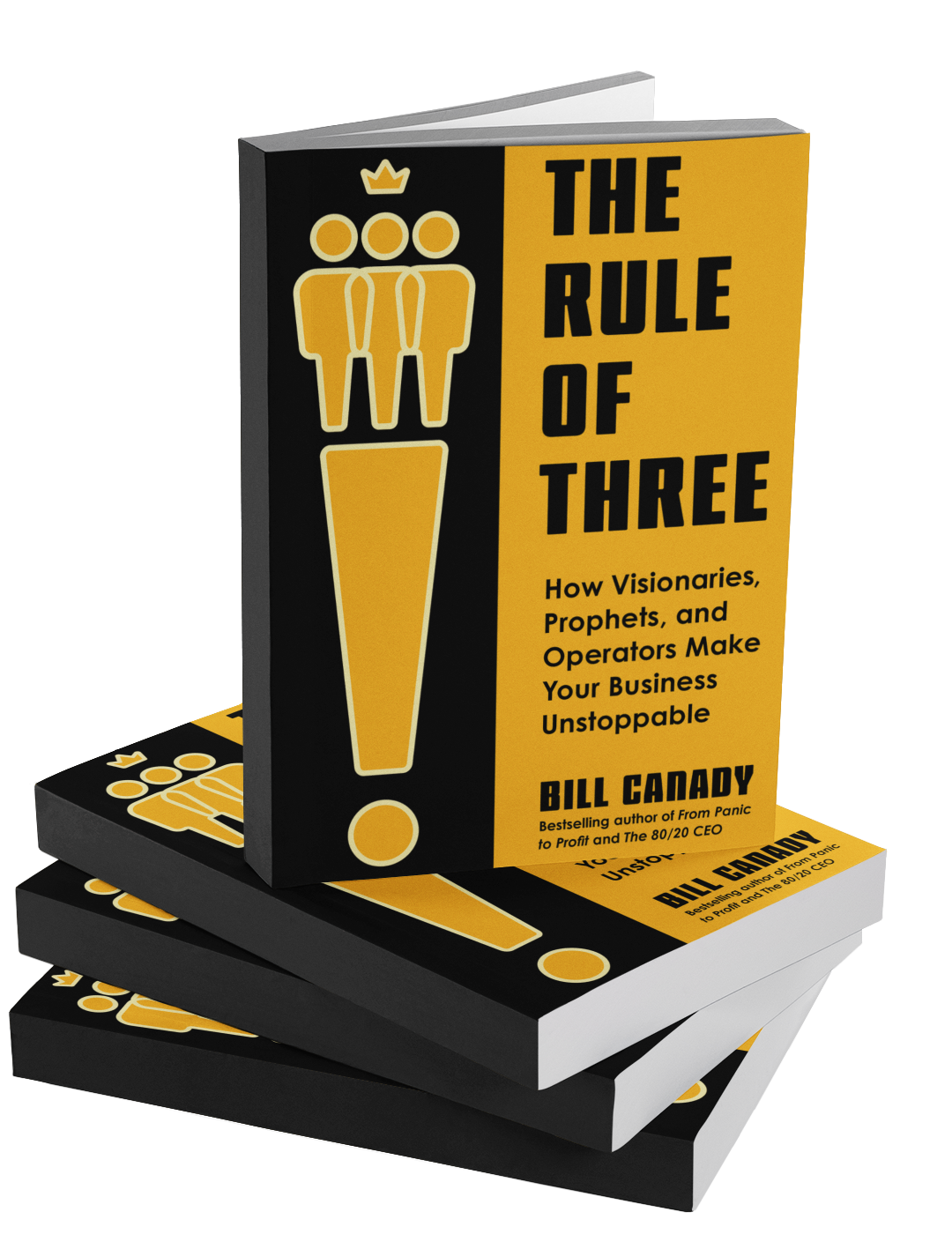
With the bridge drafted, I can finally audit the team properly, because now there is something to audit against. The question is never whether an executive is good in the abstract. It is whether this specific person can deliver this specific lever by this specific date. I use the Rule of Three: every business needs a Visionary to see where the market is going, a Prophet to make the case for change, and an Operator to make the trains run. Most inherited teams are heavy on operators, light on prophets, and have a visionary who left two owners ago. The gaps get written into an honest memo — the Capability Lock — that the board and I both sign. Not to fire people. To stop pretending.
Then comes the Team Lock: rewiring incentive compensation so the top twenty or so leaders are paid on the levers of the bridge, not on functional metrics that can be hit while the company misses. At one company I inherited a plan where the head of sales could earn a full bonus growing unprofitable volume — and had, for three straight years, rationally and destructively. We moved every senior incentive onto bridge levers by week ten. The behavior change was visible within a quarter. People do not follow strategy documents. They follow their comp plan, and they should.
Weeks 10–14: the plan the board signs
The last stretch is assembly. The 80/20 cut, the bridge, the number, the team audit, and the incentive design get compressed into a plan short enough that the board will actually read it — target is under fifteen pages, and the best version I ever produced was nine. Every initiative has an owner, a dollar value, and a date. Every assumption is labeled as an assumption. And then, in a formal session around week fourteen, the board signs it. Physically. Signatures on paper.
The signatures are not theater. They are the whole game. A signed plan converts the board from an audience into a counterparty. When the hard quarter comes — and it always comes — the conversation is not the sponsor auditing my performance against a plan that lived in their heads. It is both of us reviewing our plan against reality. That single shift in pronoun is worth more than any operating improvement I will make in year one, because it is the thing that buys the time for the operating improvements to work.
What I refuse to do in the first 100 days
The list of what I will not do is as load-bearing as the list of what I will. Three refusals, held every time, each learned the expensive way.
No reorgs. A reorg in month two is a confession that you would rather move boxes than understand the business. I redraw the org chart only after the bridge tells me what the org has to deliver — structure follows plan, never the reverse. The one time I broke this rule, early in my career, I spent month four un-reorganizing.
No cost programs. A generic 10% cost cut announced in week six takes 10% from the quartile earning 117% of your profit and 10% from the quartile losing money, which is how you shrink your best business to subsidize your worst. Cost is a lever on the bridge, aimed by the 80/20 data — not a gesture to show the board you are serious.
No strategy offsites. Two days of flip charts before anyone has seen the profit concentration produces a vision statement and a hangover, in that order. Strategy in month two is opinion. Strategy in month four, with the data cut done, is a plan. I will happily do the offsite — after the bridge exists.
How I handle the board in this window
The board gets managed as deliberately as the company in the first 100 days. My cadence: a short written note every two weeks — one page, what I have learned, what I am doing, what I need — plus a call with the lead partner every week for the first month, then biweekly. No surprises travels in both directions. If the data cut is turning up something ugly, the sponsor hears it from me in week three with a preliminary read, not in week fourteen as a reveal. Ugly news ages like fish. Sponsors can absorb almost any fact if they get it early and get it from you.
I also negotiate the rules of engagement explicitly in the first thirty days: what decisions are mine, what requires a call, what requires a meeting. And I ask the sponsor for the one thing new CEOs rarely request — the actual fund model. I want to see the entry multiple, the leverage, the assumed exit. A CEO who has seen the arithmetic stops treating board requests as arbitrary and starts anticipating them. Most sponsors are surprised to be asked. All of them, in my experience, say yes, and the relationship is different from that day forward.
A 100-day window that set up a whole hold
Company one, disguised but real. Industrial distributor, call it $800M revenue, $52M EBITDA, sponsor needed $90M in five years. The data cut in week two showed profit concentrated in two of nine regions and one of four end markets — the top slice was producing roughly 130% of profit. The bridge wrote itself: price in the strong regions where share was defensible, exit two chronically unprofitable customer tiers, and one bolt-on to consolidate the winning end market. The team audit found a world-class operator running the worst region and a caretaker running the best one. We swapped them in week nine. No reorg — one swap.
The board signed the plan on day 96. Over the following four years that company delivered $94M of EBITDA against the $90M ask, and the levers performed within a few points of the week-six bridge. I would love to claim the execution was heroic. It was not. It was ordinary execution pointed at an extraordinary concentration of profit that had been sitting in the ERP system the whole time, waiting for someone to run the cut before running the meetings.
And one that saved a hold that was already sideways
Company two. I came in as the replacement CEO in month 26 of a hold that had already missed two budgets — the seat was mine precisely because the month-18 math had claimed my predecessor. The temptation in that situation is to skip the sequence and start pulling levers immediately, because everyone is impatient and the clock is loud. I did not skip it. I compressed it. Data cut in ten days. Bridge in four weeks. The cut showed the previous plan had been built on growing a segment where the company had a Right-to-Grow ratio of about 1.3 — structurally unable to fund its own growth. The business was not underperforming its plan. The plan had been wrong.
The uncomfortable week-eight conversation was telling the sponsor their deal thesis needed surgery: stop feeding the 1.3 segment, harvest it, and redeploy everything into the segment running at 2.4. That is not a conversation you can have without the data cut, because you are contradicting the document the partners used to raise the deal. The signed replan bought eighteen quiet months, the harvest-and-redeploy delivered a $14M EBITDA swing, and the company exited a year late but above the original underwrite. The first 100 days works even when it is actually days 780 through 880. The sequence does not care when you start. It only cares that you start with the data.
The sequence is the product
Strip away the war stories and what remains is a sequence any incoming CEO can run: cut the data before you meet the opinions. Get the number in writing. Build the bridge on five levers. Audit the team against the bridge, not against sentiment. Wire the comp. Get the signatures. Refuse the reorg, the cost gesture, and the offsite until the arithmetic exists. None of it requires brilliance. All of it requires the discipline to do things in the right order while everyone around you demands visible action in the wrong order.
This sequence is what The 80/20 Institute’s 100-Day Program delivers — the same data cut, bridge, locks, and board-signed plan, run alongside you in your actual first hundred days, whether you are walking into a new seat or resetting one you already hold. I built the program because I kept watching capable CEOs improvise this window and pay for it at month 18. If a new seat is in your future, or a sideways hold is your present, start with the sequence. The opinions can wait two weeks. They always keep.
Frequently asked questions
What should a new CEO do in the first 100 days?
Run a fixed sequence: weeks 0–2, cut the profitability data by customer, product, and region before holding substantive meetings; weeks 2–6, get the exit number in writing and build an EBITDA bridge across price, mix, share, M&A, and cost; weeks 6–10, audit the leadership team against the bridge and rewire incentive comp to its levers; weeks 10–14, compress everything into a short plan the board formally signs. Avoid reorgs, blanket cost programs, and strategy offsites until the data work is done.
Why analyze data before meeting the team in a CEO transition?
Because opinions arrive pre-loaded. Executives present narratives refined over years, and a CEO who hears the stories first will unconsciously evaluate the data through them. Seeing the profit concentration first — typically the top quartile of customers and products producing 105–150% of total profit — gives the new CEO an independent baseline against which every narrative can be tested.
What is an EBITDA bridge in a new CEO plan?
It is a one-page plan connecting current EBITDA to the exit number the owner needs, decomposed into five levers: price, mix, share, M&A, and cost. Each lever carries a quantified dollar target, a named owner, and a near-term milestone. The bridge becomes the reference document for board meetings, team incentives, and capital decisions for the rest of the hold.
Why should a new CEO refuse a reorg or cost program in the first 100 days?
A reorg before the plan exists moves boxes without knowing what the structure must deliver, and a blanket cost cut takes the same percentage from the most profitable quartile of the business as from the money-losing tail, shrinking the strong business to subsidize the weak one. Both create visible activity while destroying information and trust. Structure and cost actions should follow the bridge, aimed by the 80/20 data.
How should a new CEO work with a private equity board in the first 100 days?
Set an explicit cadence — a short written update every two weeks and regular calls with the lead partner — and deliver bad news early with a preliminary read rather than saving it for a polished reveal. Negotiate decision rights up front, ask to see the actual fund model, and finish the window with a formal session where the board signs the operating plan, converting the board from an audience into a counterparty.