I have run companies that private equity firms bought, sat on boards that approved the buying, and spent thirty years inside the businesses that deal models describe from the outside. Here is what that vantage point teaches you: the difference between a good deal and a bad one is almost never in the CIM, and it is almost never in the model. It is in the transaction data, the pricing file, and the management team — three places a deal team rarely has time to look properly. I can usually tell within three weeks. This is the test I run.
The question every CIM is built to avoid
A CIM is a marketing document. Its job is to present averages, and averages are where the truth goes to die. Average revenue growth, average gross margin, average customer relationship length — every one of those numbers can be healthy while the business underneath is quietly rotting, because averages blend the twenty percent of the business that makes all the money with the eighty percent that eats it. The question the CIM avoids, and the question I start with, is: where exactly does the profit live? Not revenue — profit. By customer, by product, by customer-product pair. Until you can see that concentration, you do not know what you are buying. You know what the seller wants you to think you are buying.
Days 1–3: cut the data and find the real company
Give me transaction-level data — two years of invoices, margins, and customer records — and in three days the real company appears. It is always smaller than the reported one and almost always better. In a typical middle-market industrial or distribution business, the top quartile of customers produces something like 105 to 150 percent of the profit. The bottom half produces losses that the top is subsidizing. The ‘real company’ — the profitable core — might be 60 percent of the revenue and 130 percent of the earnings.
That single cut answers three deal questions at once. Is the moat real? A profitable core with dense, long-tenured, high-share relationships is a moat; a thin spread of transactional accounts is a coin flip. Is there hidden EBITDA? Every quartile-four customer is a future price increase, a service-model change, or a respectful goodbye — and each is worth real money. And is the growth story honest? If the model assumes growth but the core is already at high share with its best customers, the growth has to come from the unprofitable tail — which means the model is assuming the company will grow its worst business. I have watched that exact assumption sink deals that looked clean in every financial screen.
The Right-to-Grow test: earn it before you spend it
Next, one ratio: material margin divided by total employee cost. I call it the Right to Grow, and it is the fastest health check I know for an operating business. Material margin is what is left after the direct cost of what you sell; employee cost is everyone, fully loaded. When the ratio runs comfortably above 2.0, the company converts its gross economics into enough headroom to fund investment, absorb mistakes, and grow. When it runs below that, the company has not earned the right to grow — every dollar of growth spending is being taken from somewhere else, usually maintenance, price discipline, or the balance sheet.
For a deal, the ratio tells you which thesis you are actually underwriting. Above the line, you are buying a growth platform and the plan should attack share and add-ons. Below the line, you are buying a fix-first company — entirely buyable, often at better prices, but the first-year plan must be price, mix, and complexity, not expansion. The bad deals I have seen up close were mostly fix-first companies bought with growth-platform models. The company was not the mistake; the sequence was.
The team read: the Rule of Three in one week of meetings
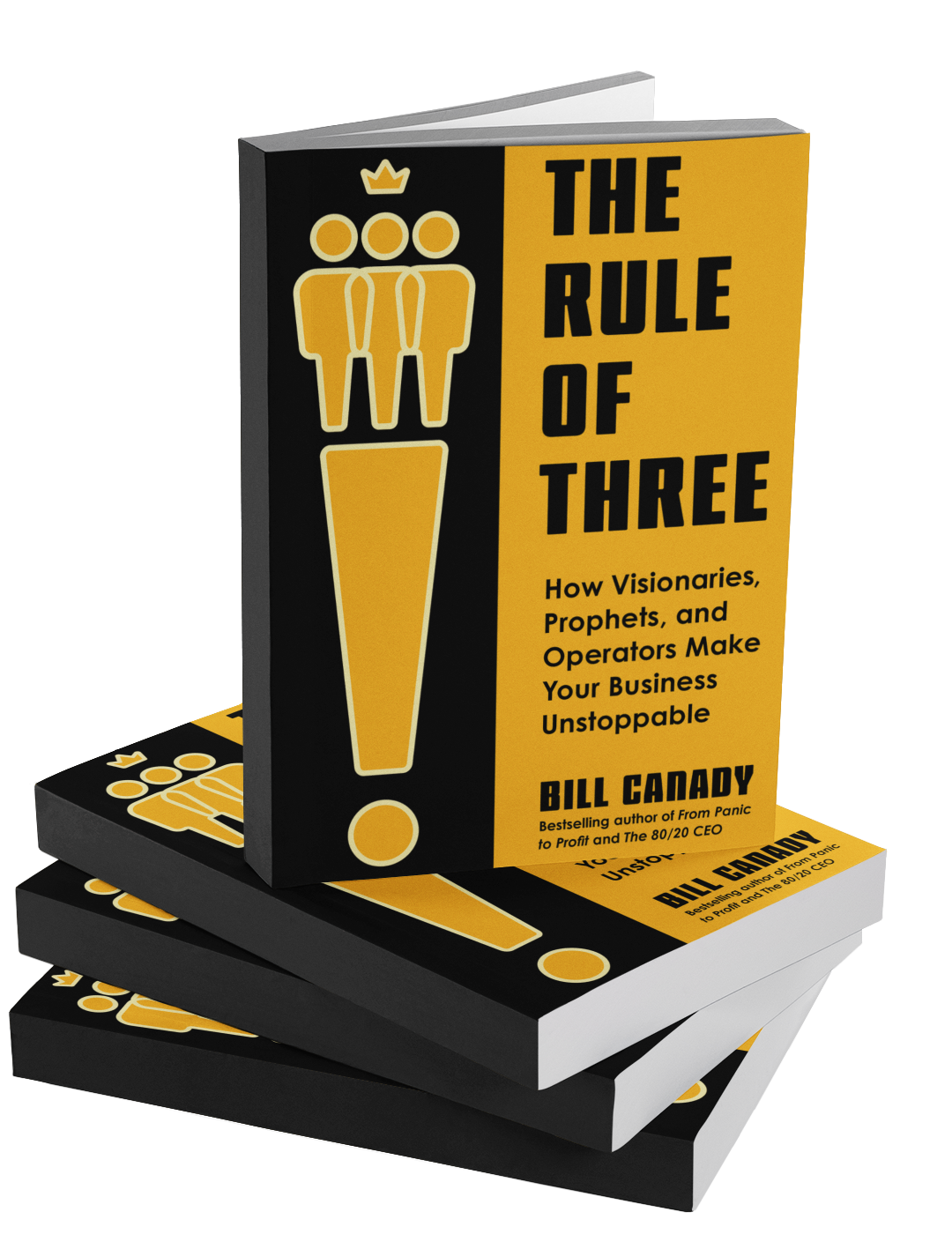
Numbers first, then people — because after the data cut I know what the plan will demand, and now I can assess the team against the actual job instead of their resumes. Every leadership team needs three capabilities in balance: the Visionary who sees where the market is going, the Prophet who translates that into a plan with numbers, and the Operator who makes the trains run. Most teams are missing one. A first week of management meetings tells me which, if I ask operating questions instead of pitch questions.
I ask the CFO to walk me through margin by customer — not whether the report exists, but whether they reach for it by instinct. I ask the sales leader which customers they would fire, and watch whether the question horrifies them. I ask the ops leader what they would fix with a million dollars, and whether the answer is a machine or a system. I ask the CEO what the company will look like in five years, and then — separately — what has to be true in eighteen months. By Friday I know whether this team can carry the bridge, which seats need support, and which need to change. Sponsors consistently underweight this. The model assumes execution; the team is the execution.
The buried treasure test: price
One more cut before I form a view: the pricing file. I look for corridor width — the spread between what the best-priced and worst-priced customers pay for the same product at similar volumes. In most middle-market companies that corridor is embarrassing: 15, 20, sometimes 30 points wide, for no strategic reason anyone can articulate. Wide corridor means weak pricing governance, and weak pricing governance means buried treasure: one to three points of realized price available inside the first year, no new customers required, no new products, no capex. On a $100M revenue company, two points of price is $2M of EBITDA — often a fifth of the whole bridge, available by month six. When the corridor is tight and disciplined, I respect the seller more and trust the margins more. Either answer is information.
The red flags that kill deals
- Profit concentration without relationship depth. The core makes all the money, but the relationships are one buyer deep, unvisited, or priced below the corridor. That is not a moat; it is a hostage situation in both directions.
- The growth assumption lives in the tail. The model grows precisely the customers the company should be exiting.
- Addbacks that describe a different company. When adjusted EBITDA requires believing the next owner will run the business a way the current owner never did, you are buying the adjustment, not the business.
- A missing Prophet. A Visionary CEO with a loyal Operator and no one who converts strategy into numbers — that gap becomes the sponsor’s problem by the second board meeting.
- A data desert. If the company cannot produce transaction-level data in diligence, everything you have been told about margin is a belief. Price accordingly, or walk.
What three weeks actually buys you
Run the concentration cut, the Right-to-Grow test, the team read, and the pricing corridor, and after three weeks one of three things is true — and every one of them is worth more than the fee. The thesis validates: you close with conviction, and the 100-day plan is already half-written because the diagnostic is the plan’s first chapter. The thesis adjusts: the deal is real but the model was wrong about where the value comes from, and you reprice or restructure with evidence in hand. Or the thesis fails: you walk from a company that would have cost you four years, a fund slot, and a management drama — for the price of three weeks of work. I have delivered all three answers to sponsors. Nobody has ever complained about the third one.
The era when the exit multiple forgave a mediocre buy is over. What you pay still matters, but what you buy — the real company under the averages, and the team that has to run the plan — matters more. Three weeks tells you both. If you have a deal in diligence and the operational answer is still a set of assumptions, that is exactly the engagement my team and I run.
Frequently Asked Questions
What is operational due diligence in private equity?
The pre-close work that tests whether the investment thesis can actually be executed by the target company: transaction-level profit concentration analysis, pricing corridor review, the Right-to-Grow ratio, and a capability audit of the management team. It complements the QofE, which confirms earnings are real but not whether the plan is achievable.
What is the fastest way to assess an acquisition target’s health?
Two cuts of transaction data: an 80/20 profit concentration analysis by customer and product, and the Right-to-Grow ratio (material margin divided by total employee cost). Together they show where the profit lives, whether the moat is real, and whether the company should grow or fix first — typically within days of receiving data.
What are the biggest red flags in a deal?
Growth assumptions that depend on unprofitable customers, EBITDA addbacks that describe a company the seller never ran, a pricing corridor 15+ points wide with no governance, a management team missing the Prophet role (strategy-to-numbers translation), and an inability to produce transaction-level data in diligence.
How long should pre-close operational validation take?
Three to six weeks, run in parallel with confirmatory diligence inside the deal window. The output is a board-ready readout: thesis validated, adjusted, or challenged, with an EBITDA bridge grounded in the target’s own data and a first-100-days plan skeleton.
What is the Rule of Three for management teams?
Every leadership team needs three capabilities in balance: a Visionary (sees where the market is going), a Prophet (translates vision into a plan with numbers), and an Operator (executes reliably). Most teams are missing one, and identifying which gap exists — before close — tells a sponsor what the plan will really cost to execute.