What did $3 billion in shareholder value actually take? Not genius. I want to say that in the first paragraph because every other answer you will read starts with the implication that the person writing it is special. The honest decomposition is less flattering and more useful: it took sequence, repetition, and a stubborn refusal to skip steps, applied across multiple companies over thirty years. Today I am Chairman and CEO of a $1.5 billion PE-backed industrial company and chairman of a business closing in on a billion, and before that I ran a company roughly twice that size. When I add up the value my teams created across all those seats, the number crosses $3 billion. This post is my attempt to take that number apart honestly — what it is made of, what the mistakes inside it cost, and why almost none of it required anything you do not already have access to.
I am writing it because the number gets used against people. A CEO hears “three billion in shareholder value” and files the speaker under a different species — someone with proprietary insight, a golden network, a gift. That filing is convenient and wrong, and it lets the listener off the hook. If value creation is magic, you are excused from doing it. If it is arithmetic and cadence — which it is — you are not.
What the Number Is Actually Made Of
Decompose the $3 billion and the largest single ingredient is embarrassingly dull: price and mix, compounding across companies and years. Not one heroic repricing — hundreds of small ones. A point and a half here on a product family that was underpriced against its alternatives. Two points there when we finally segmented customers by cost-to-serve and stopped subsidizing the bottom quartile. A mix shift toward engineered product that added margin without adding a single machine. Any one of those moves is a footnote. Run them every year, in every business unit, in every company you touch for three decades, and they become the majority of the bridge. Price is the fastest lever and the most neglected one, and the neglect is why it kept working for thirty years.
The second ingredient is complexity removed and never allowed back in. Every business I have ever taken over was carrying products, customers, and activities that consumed more than they contributed — usually invisible because the accounting averaged them into the herd. The 80/20 work of cutting the tail is well understood. The part that created the value was the second half: refusing to let the tail regrow. Complexity is a weed with a marketing department. Every year somebody has a compelling reason to add back the low-volume SKU, the unprofitable region, the customer who left angry and wants to return on the old terms. The companies where the value compounded were the ones where the answer stayed no.
The third ingredient is teams locked to plans. Not talented teams — locked ones. A numbered plan with five levers, an owner and a date on every line, reviewed on a cadence that never moved. The fourth is a handful of well-priced add-on acquisitions: not many, not clever, just bolt-ons bought at sensible multiples where the integration math was done before the letter of intent, not after. That is the whole recipe. Four ingredients. You will notice that “visionary bet” and “proprietary technology” do not appear. In my ledger they round to zero.
The Mistakes Inside the Number
An honest decomposition has to include the subtractions, because the $3 billion is a net figure and the gross was higher. The biggest single subtraction was an acquisition I should not have done. Mid-sized industrial distributor, adjacent market, seller’s banker ran a tight process and I let the competitive dynamics of the auction substitute for my own diligence discipline. We won, which in an auction often means we were the most wrong about the asset. The synergies were real but half the size we underwrote, the customer concentration was worse than the data room suggested, and two years of management attention went into fixing a business that should never have been ours. Call it a nine-figure hole in the gross number, plus the opportunity cost of what that team could have built instead. The lesson was not “diligence harder.” It was: never let the process set your pace. We had a playbook and I skipped steps because the clock was someone else’s.
The second expensive mistake was a year I waited too long on a team change. A division president — good man, loyal, had earned his seat in an earlier era — was visibly not the person to run the numbered plan we had built. I knew it in the first quarter. I acted five quarters later. In between, the division missed its bridge four straight times, two of his best people left because they could see what I was pretending not to, and the eventual transition was harder because the successor inherited a demoralized team instead of an intact one. I have run the math on what those five quarters cost in EBITDA and in exit multiple, and it is the most expensive act of kindness I have ever committed. It was not even kindness. It was my own discomfort, dressed up as patience.
Why I Publish the Mistakes
I itemize the failures for a practical reason, not a confessional one. The mistakes are where the transferable lessons live. Nobody can copy my successes directly — different companies, different markets, different decades. But the failure modes are universal. Every CEO reading this either has an auction they are being rushed through or a leader they are slow-walking a decision on, right now, today. The $3 billion figure is only useful to you if you can see that it was built by someone who committed both errors, paid for them, and kept the receipts.
What It Took Personally
Here is the part the case studies leave out. The playbook is arithmetic, but running it for thirty years is a physical act. It took the meetings — thousands of monthly operating reviews, most of them unremarkable, all of them held. It took the travel: you cannot fix a plant from a dashboard, and the most important facts in every turnaround I have run were standing on a shop floor or sitting in a customer’s office, not in the reporting pack. It took the discipline of asking the same questions for thirty years — what does the bridge say, who owns this line, what is the countermeasure — long after the questions stopped being interesting to me. Boredom is the tax on compounding. Most leaders quit paying it around year three and go looking for a new idea. The value went to the ones who kept asking.
It also took a certain comfort with being the least exciting person in the room. Sponsors and boards are drawn to novelty; the operator’s job is to be the person who says the plan from last quarter is still the plan, and here is the variance. I have sat through a hundred board meetings where the most valuable thing I did was decline to be interesting.
What It Did Not Take
It did not take heroics. I can count on one hand the moments in thirty years that resembled a movie scene, and honestly most of those were self-inflicted crises that better sequencing would have prevented. It did not take eighty-hour weeks forever. There were sprints — the first hundred days after a close, the quarter a covenant got tight — but the system exists precisely so the company does not run on the CEO’s adrenaline. A business that needs its leader to be superhuman is a badly designed business. And it did not take proprietary insight. I have never once known something about a market that a diligent competitor could not also have known. The edge was never the information. The edge was doing the obvious things in the right order without skipping steps, which sounds available to everyone and is chosen by almost no one.
Sequence. Data before decisions, focus before growth, team before plan, plan before cadence. Every expensive failure I have watched — mine included — was a right action taken out of order.
Repetition. The same five levers, the same review questions, the same one-page bridge, every month, in every company, for thirty years. The returns come from the two-hundredth repetition, not the first.
Refusal to skip steps. The shortcut is always available and always costs more than the step it replaced. The acquisition I should not have done was a skipped step with a wire transfer attached.
The Three Locks, Opened in Order
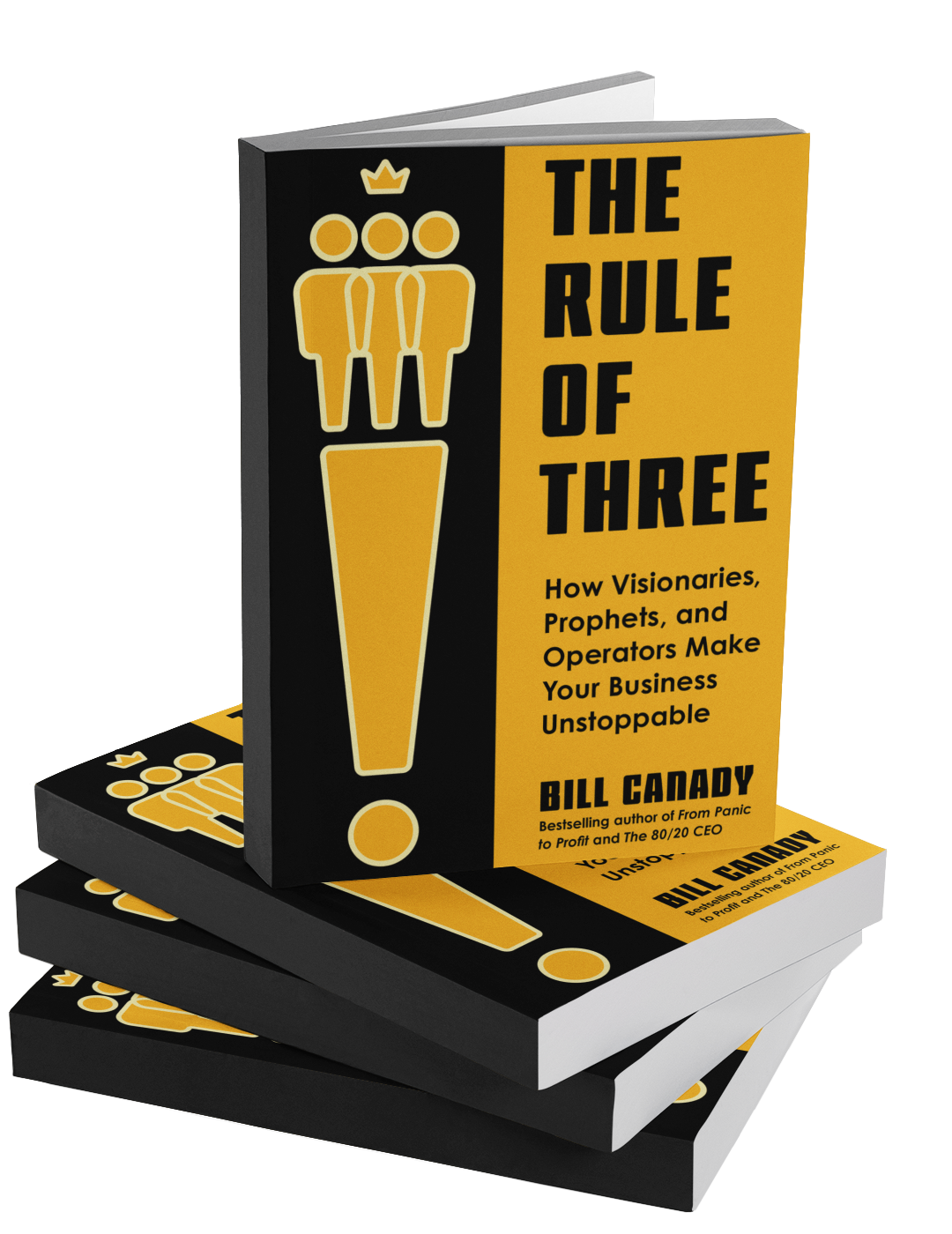
If you want the sequence in its compact form, it is what I call the Three Locks. The first lock is focus: use 80/20 to find where the profit actually lives and strip away everything that obscures it. The second lock is the team: the Rule of Three — a Visionary who calls the market, a Prophet who numbers the plan, an Operator who runs the weeks — with every chair genuinely filled. The third lock is the plan itself: a five-lever EBITDA bridge with owners and dates, run on a cadence. The locks only open in order. A brilliant plan handed to the wrong team is paper. A great team pointed at an unfocused business optimizes noise. Every company in the $3 billion went through the same three doors in the same order, and the ones that tried to go through door three first all came back to door one eventually, poorer.
The order is worth a story, because I violated it once and paid retail. Early in my chairman years I inherited a business where the plan looked ready-made — the prior CEO had left behind a credible bridge, and the fastest apparent path was to hand it to the team and start the cadence. Lock three, straight away. Within two quarters it was obvious why the prior regime had failed with the same document: the business had never been focused, so half the plan’s lines were built on averaged data that concealed which customers actually made money, and the team included two executives who could not own a number if you engraved it on their desks. We stopped, went back to lock one, and lost about nine months relearning what the sequence would have told us for free. The doors open in order because each one supplies the material the next one is built from. There is no clever path around that, and I have watched clever people look for one at extraordinary expense.
Earning the Right to Grow
One number governed the timing in every case: what I call the Right-to-Grow ratio. Until a business demonstrates it can convert revenue into profit at roughly a 2.0 ratio on its core — profit growing at twice the rate of the resources consumed to get it — it has not earned the right to chase new revenue. Growth on top of a leaky operating model just scales the leaks. The single most common way I have seen CEOs destroy value is growing before they had earned it: new segments, new geographies, new products, all bolted onto a core that had never been fixed. The discipline of shrinking first — cutting the tail, fixing price, locking the team — is what made the later growth stick. In every one of my companies, the growth phase was the easy part. It only looked easy because of the two unglamorous years in front of it.
Why the Playbook Transfers
The question I get most often, usually from a sponsor, is some version of: does this only work for you? It is a fair question and the answer is no, for a structural reason. Nothing in the playbook depends on judgment that cannot be written down. Which customers make money is a data question. What price the market will bear is a testing question. Whether the plan has an owner on every line is a reading question. The five levers — price, mix, share gain, M&A, cost — are the same five levers in every industrial business I have ever seen, and the bridge template does not care who fills it in. I have now watched the same system run by CEOs I trained, in companies I never operated, and the results rhyme. The constraint is never the method. The constraint is the willingness to run it without improvising, which is a character trait, not a talent.
That is also why I am suspicious of value creation stories that do not transfer. If a track record only works with one person’s hands on it, it is not a system — it is a performance. Performances do not compound and they do not exit well. Systems do both.
Boring Quarterly, Astonishing Decadally
The compounding lesson deserves its own heading because it is the one nobody believes until they live it. Value creation is boring quarterly and astonishing decadally. A quarter of good price discipline is a rounding error. A year of it is a nice bridge line. A decade of it, layered on mix and cost and a few sane acquisitions, is a company worth four times what anyone thought it could be. The math is not linear and neither is the credit: for the first several years of any of these journeys, the numbers were fine and the narrative was dull, and I got asked at every board meeting whether we should be doing something bolder. The answer that created $3 billion was no. The discomfort of being undramatic for years at a time is, as far as I can tell, the actual price of the number in this post’s title.
There is a second-order effect worth naming, because it is where multiple expansion used to hide. For most of my career, a buyer would pay a higher multiple for a business than the seller had paid, and that spread flattered everyone’s returns. That era is over — rates and competition have seen to it — which means the exit math now has to be earned inside the P&L, dollar by dollar, over the hold. This changes nothing about the playbook and everything about its urgency. When the multiple did the work, a sponsor could tolerate a CEO who ran the business sideways for five years. Now the bridge is the deal. The boring quarterly discipline is no longer one path to a good exit; it is the only path that remains. I consider this the best thing that has happened to operators in twenty years, because it repriced our craft. The market finally pays for what the work always was.
What I Tell CEOs Who Want the Shortcut
Every few weeks a CEO asks me, in some polite form, for the compressed version — the one move that matters most, the thing they can do this quarter. I give them a straight answer: the shortcut is the sequence. Not a step within it, the sequence itself. Most companies have all the ingredients of the bridge lying around — pricing power unexercised, a tail unexamined, a plan without owners — and the fastest path to value is not a new ingredient but the discipline of assembling the existing ones in order. That usually lands as a disappointment, because it means the constraint is them. Then, about one time in three, it lands as a relief, because it means the constraint is them. Those are the CEOs who go on to build their own version of this number.
If you are one of those, and you sit in a sponsor-backed seat, the playbook in this post is what my firm delivers as an engagement — the diagnostic, the bridge, the cadence, installed with your team rather than presented to them. The place to start is the private equity page. Bring your last twelve months of financials and an honest answer about which steps you have been skipping. The arithmetic will do the rest. It always has.
Frequently Asked Questions
How Was the $3 Billion in Shareholder Value Actually Created?
The decomposition is mostly unglamorous: price and mix improvements compounding across multiple companies and years, complexity removed through 80/20 segmentation and never re-added, leadership teams locked to numbered five-lever EBITDA plans, and a small number of well-priced add-on acquisitions. Visionary bets and proprietary technology contributed almost nothing. The edge was sequence and repetition, not insight.
What Is the Biggest Mistake Operators Make When Trying to Create Shareholder Value?
Skipping steps in the sequence — most commonly growing before the core business has earned the right to grow, or letting a deal process set the pace of an acquisition instead of running their own diligence discipline. Growth on top of an unfixed operating model scales the leaks, and auctions won in a hurry are usually won by the buyer who was most wrong about the asset.
Does Creating Shareholder Value Require Exceptional Talent or Long Hours?
No. It requires a repeatable system run without improvisation: 80/20 focus first, the right team second, a numbered plan third, and a review cadence that never moves. There are sprints — the first hundred days after a close, for example — but a business that depends on a heroic CEO working eighty-hour weeks indefinitely is a badly designed business.
What Is the Right-to-Grow Ratio?
A discipline test: a business earns the right to pursue new growth when its core demonstrates it can convert resources into profit at roughly a 2.0 ratio — profit growing about twice as fast as the resources consumed to produce it. Until then, the highest-return work is shrinking and fixing the core: cutting unprofitable complexity, repairing price, and locking the team to a plan.
Can This Value Creation Playbook Transfer to Other CEOs and Companies?
Yes, because nothing in it depends on judgment that cannot be written down. Which customers make money, what price the market bears, and whether every plan line has an owner are data, testing, and reading questions. The five levers — price, mix, share, M&A, cost — are the same in every industrial business. The constraint is the willingness to run the system in order without skipping steps.