Which role is your leadership team missing? In thirty years of running and chairing industrial companies, I have never seen a business grow on purpose without three roles filled at the top: a Visionary who sees where the market is going, a Prophet who translates that vision into a numbered plan, and an Operator who turns the plan into what the company actually does on Tuesday. Most teams have two of the three. The one that is missing, in roughly four cases out of five, is the Prophet. That is the short answer. The rest of this post is the long one, because the long one is where the money is.
I have watched this movie from every seat. I have been the Operator promoted too early, the CEO trying to be all three roles at once, and the chairman watching a talented team stall for reasons nobody in the room could name. Today I am Chairman and CEO of a $1.5 billion PE-backed industrial company and chairman of a business closing in on a billion. Across those seats my teams have created more than $3 billion in shareholder value. Every dollar of it traces back to getting these three roles filled and keeping them filled. Every stall I have ever been called in to fix traces back to one of them being empty.
Where the Rule of Three Came From
It started as a diagnosis, not a theory. Years ago I inherited a leadership team at an industrial company doing about $400 million. On paper the team was excellent. The CEO before me had been a genuine visionary — he saw the shift to integrated supply five years before the competition did. The COO was a machine. Plants ran, orders shipped, safety numbers led the industry. And yet the company had missed its plan three years running, each time by a wider margin. The board thought it had a strategy problem. It did not. It had a translation problem.
The vision was right and the execution muscle was real. What was missing was the person in the middle — someone who could take the phrase win in integrated supply and turn it into a numbered answer: which customers, which margin, what price moves, what capacity, what it costs, what it earns, and by which quarter. Nobody owned that translation. So the Operator executed last year’s business harder while the Visionary described a future nobody had costed. The gap between them compounded quietly until it showed up as three missed plans. Once I saw the pattern in that company, I started seeing it everywhere. I wrote a book about it because I got tired of drawing it on whiteboards.
The Visionary Sees the Market
The Visionary answers one question: where is the profit pool moving? Not where is it today — where will it be in three to five years, and what position do we need to hold when it gets there. Real Visionaries are rarer than the conference circuit suggests. Plenty of executives can recite trends. A Visionary makes a call — this segment consolidates, this channel dies, this technology resets the cost curve — and commits the company to it before the evidence is comfortable.
The best Visionary I ever worked with ran a components business doing roughly $250 million. In one meeting he told the board that a third of the product line would be commoditized by Asian entrants within four years, and that the company should stop defending it now and redeploy toward the engineered end of the catalog. He was wrong on timing — it took six years — and right on everything else. The companies that ignored the same signal sold for scrap multiples. Vision is not creativity. It is the discipline to look at the market as it will be and say so out loud.
The Prophet Translates Vision Into a Numbered Plan
The Prophet takes the Visionary’s call on the market and converts it into arithmetic. Which customers get us there. What price and mix moves fund the journey. What the EBITDA bridge looks like — price, mix, share, M&A, cost — quarter by quarter, with names and owners attached. The Prophet is the person who can hold the vision in one hand and the general ledger in the other and make them agree. When I build a value creation plan, I am doing Prophet work: five levers, one page, numbered targets that a board can hold someone accountable to.
Notice what the Prophet is not. The Prophet is not the strategy consultant who leaves a deck. Not the CFO who reports what happened. Not the planner who reconciles budgets. The Prophet is an interpreter with authority — close enough to the Visionary to understand intent, close enough to operations to know what the machine can actually do, and fluent enough in numbers to state the plan so precisely that failure has nowhere to hide. That combination is rare, which is exactly why the role is so often vacant and so rarely missed by name.
The Operator Turns the Plan Into Tuesday
The Operator answers the third question: what does the company do this week? Operators run the cadence — the weekly reviews, the monthly operating rhythm, the countermeasures when a number goes red. A great Operator is worth a fortune and is usually underpaid relative to that worth. I say this with affection, because operating is where I grew up. Give me a numbered plan and a room of adults and I will beat it. That is the Operator’s craft: relentless, unglamorous conversion of a plan into shipped orders and collected cash.
But an Operator without a Prophet is a very expensive way to go fast in the wrong direction. I once watched an Operator take fourteen points of cost out of a business over two years — genuinely impressive work — while the segment his company depended on shrank underneath him. He hit every internal number. Enterprise value went down anyway. Nobody had translated the market shift into his plan, so his plan was a beautifully executed answer to the wrong question. He was not the problem. The empty chair next to him was.
The Failure Pattern of Each Missing Role
Each vacancy produces its own signature failure, and once you know the signatures you can diagnose a company from its symptoms. Missing the Visionary, the company optimizes yesterday. Margins hold, cadence hums, and the whole enterprise drifts toward irrelevance in exquisitely well-managed fashion. These businesses look healthy right up until the market moves and they discover they have been sharpening a knife nobody wants to buy. It is the slowest failure and the most comfortable one, which is what makes it dangerous.
Missing the Operator, the company has brilliant meetings and nothing ships. The vision is compelling, the plan is numbered, and execution dissolves into heroics and apologies. You can spot this one in a single quarterly review: lots of narrative, no countermeasures, the same red items as last quarter with fresher excuses. Missing the Prophet — the epidemic case — the company has energy at the top and competence at the bottom and a void in between. The Visionary keeps announcing destinations. The Operator keeps running last year harder. Both are working flat out, both are frustrated, and the plan misses again. When a CEO tells me the team works hard but the numbers never move, I stop listening for effort and start looking for the missing translator.
Why the Prophet Gap Is Epidemic in the Middle Market
Middle-market companies grow their leaders from two nurseries: sales and operations. Sales produces Visionary-adjacent leaders who can see customers and markets. Operations produces Operators who can run the machine. Neither nursery produces Prophets, because translation is not a function anyone is hired into. There is no VP of Turning the Vision Into a Numbered Plan on the org chart. The work falls into the seam between strategy and finance, and work that lives in a seam gets done by nobody.
Big companies paper over the gap with strategy departments and FP&A armies — expensively and often badly, but they paper it. A $200 million company has no such padding. The founder holds the vision, the GM holds the wrench, and the annual plan is last year plus six percent. I have reviewed the operating plans of dozens of middle-market companies as a chairman, an acquirer, and an advisor, and I can count on one hand the ones that contained an actual EBITDA bridge with named owners. The rest were budgets wearing a strategy costume. That is the Prophet gap, written down.
How the Three Roles Map to a Private Equity Hold
If you run a sponsor-backed company, the Rule of Three maps directly onto your hold period. The Visionary work is the investment thesis — the specific belief about the market that justified the entry multiple. The Prophet work is the value creation bridge — thesis converted to numbered EBITDA moves across the five levers. The Operator work is the cadence that delivers the bridge quarter after quarter until exit. Miss any of the three and the hold goes sideways, and the industry data says most holds do: roughly seventy percent of PE-backed CEOs are replaced, most of them in months eighteen through twenty-four.
That eighteen-to-twenty-four-month window is not a coincidence. It is exactly how long a Prophet gap takes to surface. Year one, everyone credits the transition. Somewhere in year two, the board notices that the thesis and the operating plan have never actually been introduced to each other, and the CEO — who was usually hired as an Operator and left to do all three roles alone — pays for the vacancy with his job. In an era where multiple expansion is dead and the exit math has to be earned inside the P&L, sponsors can no longer afford to leave the translation role to chance. The bridge is the deal now.
Diagnose Your Own Team
You do not need a consulting study to find your gap. You need honest answers to a handful of questions. Sit your leadership team down — or sit alone with a legal pad, which is cheaper and often more honest — and work through these:
The market call
Can anyone on the team state, in one sentence, where your industry’s profit pool will be in five years and what position you are building toward? If the answer is a trend recital rather than a call, the Visionary chair is empty.
The bridge
Does a document exist that connects that market call to a numbered EBITDA plan — price, mix, share, M&A, cost — with owners and dates? If your strategy lives in a vision deck and your numbers live in a budget and no page connects them, you have no Prophet.
The cadence
Is there a weekly and monthly rhythm where red items get countermeasures rather than commentary? If reviews are storytelling hours, the Operator chair is empty no matter whose title says otherwise.
The miss autopsy
When you missed plan last time, did the explanation name a market shift, a translation failure, or an execution failure? Teams that cannot classify their misses usually cannot see their vacancy.
The succession test
If each of your top three leaders left tomorrow, which departure would leave a question nobody else can answer? That question marks the role most thinly held.
Score yourself harshly. In the workshops I run, most CEOs walk in confident they have all three roles covered and walk out having named a vacancy. The confident ones are usually covering the gap personally, at night, badly — which brings me to the next point.
One Person Can Hold Two Roles. Never Three.
The Rule of Three is about roles, not headcount. Plenty of great CEOs hold two chairs. Visionary-Prophets who see the market and can build the bridge themselves — many founders at their best. Prophet-Operators who take someone else’s thesis, number it, and grind it out — the classic great PE-backed CEO. I have run companies as a Prophet-Operator most of my career, borrowing vision from boards, founders, and sponsors who had it in surplus. Two roles in one skull is demanding but workable, provided the person knows which two they hold and staffs the third deliberately.
Three roles in one skull is a lie that lasts about six quarters. The failure is not intelligence; it is physics. Visionary work requires leaving the building, Prophet work requires a closed door and a spreadsheet, and Operator work requires being in the cadence every single week. The calendars cannot coexist. Every CEO I have ever seen claim all three was actually doing one well, one occasionally, and one in name only — and the company’s results would tell you which was which within an hour of looking. Know your two. Hire, partner, or contract for the third. There is no fourth option that works.
How Boards Should Use the Rule of Three in CEO Selection
Most CEO searches are run against a generic leadership spec — strategic, results-oriented, inspirational, the usual laminated adjectives. That spec has no opinion, so the search defaults to charisma, and charisma correlates with the Visionary profile. Boards keep hiring compelling market-callers to sit on top of companies whose actual vacancy is translation or cadence. Then they act surprised at month twenty when the numbers arrive. The fix is to diagnose before you spec: decide which of the three roles the incumbent team genuinely covers, and write the search for the missing one by name.
This also changes how you interview. For a Prophet-shaped vacancy, do not ask candidates about their vision — ask them to build a bridge in front of you. Give them the thesis and a P&L and ninety minutes. For an Operator vacancy, ask them to walk you through their weekly cadence in enough detail that you could run it yourself Monday. The role tells you the test. A board that cannot name the role it is hiring for is delegating its most important decision to a recruiter’s gut.
The Search That Changed When We Named the Gap
A few years ago I chaired the board of a sponsor-backed industrial services company doing about $300 million. The CEO was retiring, and the search spec that came back from the firm was the usual all-things document. We were three finalists in — all polished, all visionary in the brochure sense — when we stopped and ran the diagnostic on the team the new CEO would inherit. The founder-chairman still supplied genuine market vision from his board seat. The COO ran a cadence you could set a watch by. What the company had never had, in twenty years, was a numbered plan connecting the two. The vacancy was the Prophet, and we had been interviewing for a second Visionary.
We rewrote the spec around one sentence: this person must convert an existing thesis into a five-lever EBITDA bridge and hold the organization to it. Two of the three finalists dropped out of contention within one working session each — good executives, wrong chair. The eventual hire was a candidate the original spec would have screened out: an unglamorous divisional president with a track record of numbered plans that came true. Eight quarters later EBITDA was up just over forty percent on essentially flat revenue, all of it out of price, mix, and cost — the levers a Prophet pulls. Same vision. Same cadence. One chair filled. Naming the gap did not just change the search. It changed the company.
Start With the Diagnosis
The Rule of Three is not a personality framework and I would ask you not to treat it like one. It is a structural claim about how enterprise value gets created: someone must see the market, someone must number the plan, someone must run the weeks. When all three are held, growth looks almost boring. When one is vacant, no amount of effort from the other two compensates, because effort is not a substitute for a role.
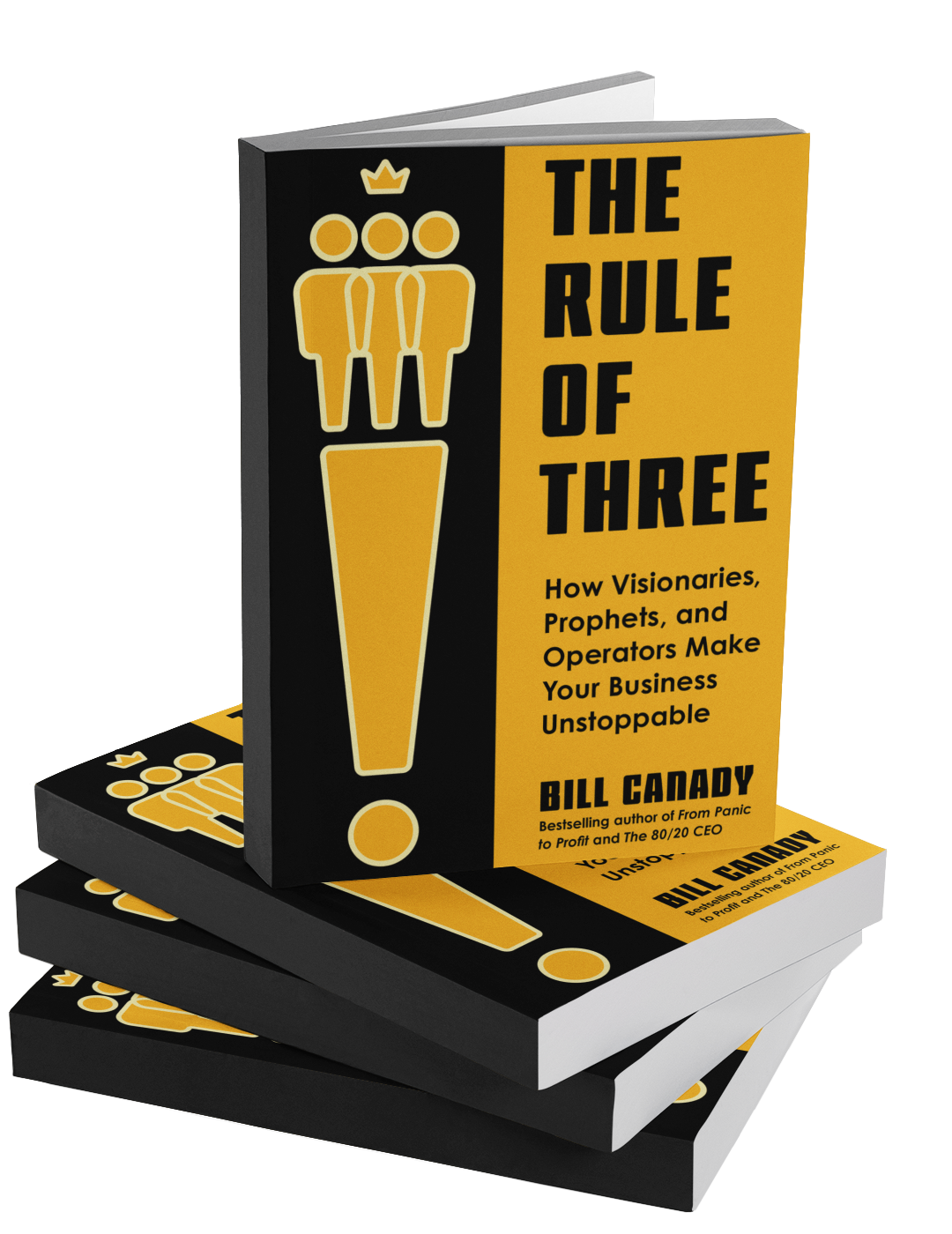
I wrote The Rule of Three to give operators and boards the full playbook — the failure patterns, the pairing rules, the hiring specs, the board mechanics. If you want the shortest possible path to your own answer, we built a free diagnostic at diagnostic.8020institute.com that will tell you in a few minutes which role your team is missing and what it is costing you. Take it before your next planning cycle, not after. The gap does not close itself, and it bills you quarterly.
Frequently asked questions
What is the Rule of Three in leadership?
The Rule of Three says every leadership team needs three roles filled to grow on purpose: a Visionary who sees where the market is going, a Prophet who translates that vision into a numbered financial plan, and an Operator who executes the plan through a weekly operating cadence. Most teams have two of the three; the missing role — usually the Prophet — explains most chronic underperformance.
Why is the Prophet the most commonly missing role?
Middle-market companies grow leaders through sales and operations, which produce Visionaries and Operators respectively. Nobody is hired into translation. The Prophet’s work — converting strategy into a numbered EBITDA bridge with owners and dates — falls into the seam between strategy and finance, and work that lives in a seam gets done by nobody.
Can one person hold more than one of the three roles?
One person can hold two roles well — Visionary-Prophet founders and Prophet-Operator CEOs are common and effective. No one can hold all three, because the calendars conflict: vision requires leaving the building, translation requires closed-door analysis, and operating requires living in the weekly cadence. Know your two roles and staff the third deliberately.
How does the Rule of Three apply to private equity-backed companies?
The three roles map directly to a PE hold: the Visionary work is the investment thesis, the Prophet work is the value creation bridge that numbers the thesis across price, mix, share, M&A, and cost, and the Operator work is the cadence that delivers it. Roughly seventy percent of PE-backed CEOs are replaced, most in months eighteen to twenty-four — typically when an unnamed Prophet gap surfaces.
How do I find out which role my team is missing?
Test three things: can anyone state a one-sentence market call, does a document exist connecting that call to a numbered EBITDA plan with owners, and does your weekly rhythm produce countermeasures rather than commentary. The free diagnostic at diagnostic.8020institute.com walks you through the assessment in a few minutes.