The visionary needs an operator the moment the company’s growth depends more on finishing things than on imagining them — and in my experience that moment arrives two years before anyone admits it. I’ve spent thirty years around founder-led and PE-backed companies, and I’ve never once watched a business stall because the person at the top ran out of ideas. Not once. They stall because nobody converts the ideas into a machine that runs without the founder’s hands on it every day. The fix is a specific hire — an Operator, an integrator, whatever your favorite framework calls it — and the fix fails more often than it works because people hire the title instead of the function. This post is about how to know it’s time, what the job actually is, where the good ones hide, and how to keep the pairing from blowing up.
A word on where I sit when I say this. I’m the Chairman and CEO of a $1.5 billion PE-backed industrial company and chairman of another business near a billion in revenue. Across my career the teams I’ve led have created more than $3 billion in shareholder value, and almost all of it came from execution machinery, not inspiration. I’ve been the operator brought in beside a visionary, I’ve hired operators for visionaries, and I’ve fired a few. What follows is the pattern.
The Visionary Ceiling Is Real — and It Has Nothing to Do With Ideas
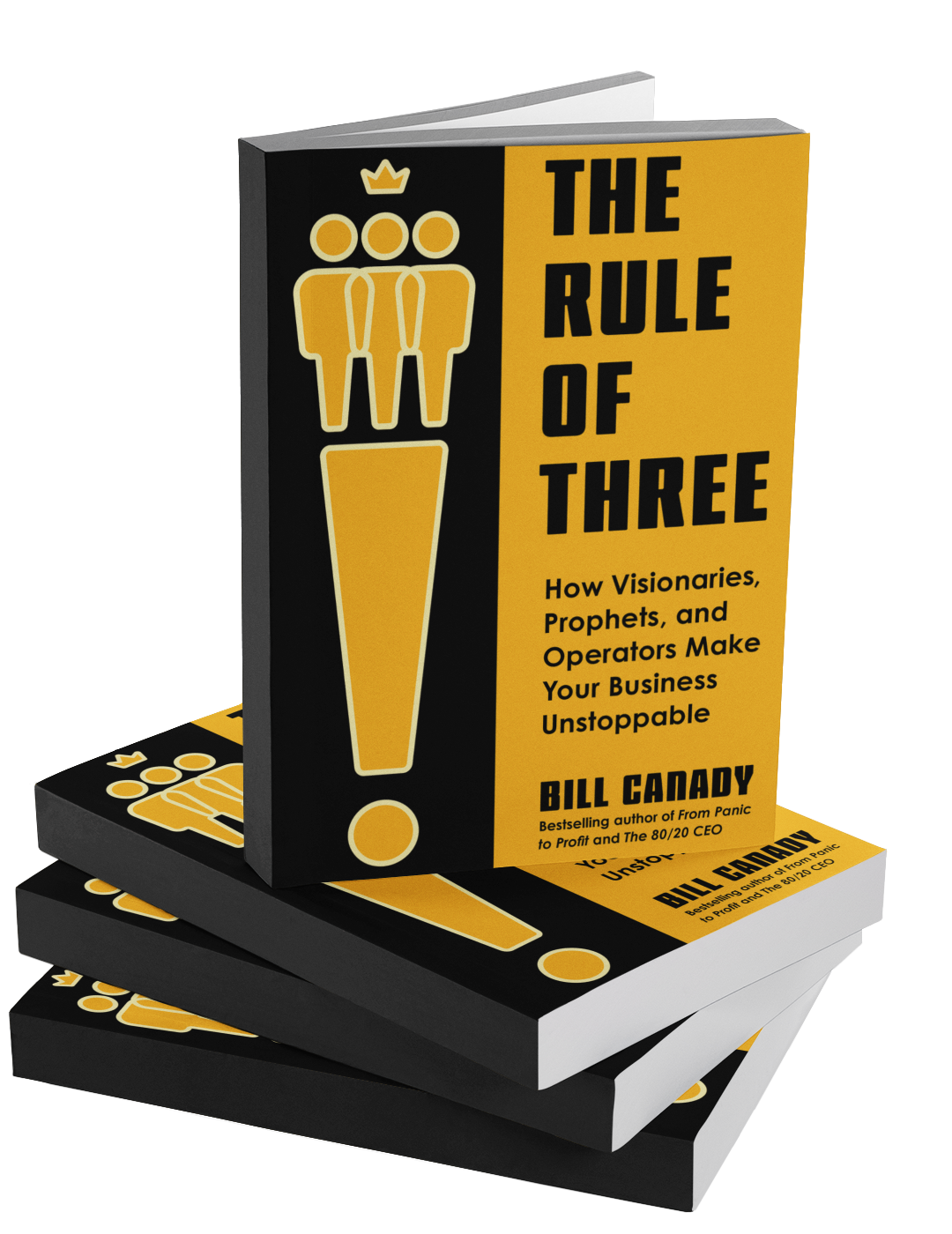
In my Rule of Three framework, every winning company needs three functions covered: a Visionary who sees the market, a Prophet who translates that vision into a numbered plan, and an Operator who executes the plan through people and cadence. Most founder-led companies are magnificently overweight in the first seat and starved in the third. The founder sees around corners. The founder closes the big accounts. The founder is also the reason the warehouse move is eight months late.
The ceiling shows up in the numbers before it shows up in the org chart. A company I worked with had grown from roughly $30 million to $85 million on the strength of one man’s instincts — genuinely brilliant instincts. Then it sat between $82 million and $88 million for four straight years. Same founder, same instincts, same market tailwind. What changed was the load. At $30 million a visionary can personally push every initiative over the line. At $85 million there are forty initiatives and one set of hands. The company didn’t lack vision. It lacked throughput.
How to Know It’s Time: The Telltale Symptoms
You don’t need a consultant to diagnose this. You need an honest look at how work actually moves through your company. Here’s my checklist, built from a couple of decades of walking into these situations:
- Everything routes through one person. Pricing exceptions, hiring approvals, the choice of carpet for the new office — if the queue outside one door is the company’s real operating system, you’ve found the bottleneck.
- Initiatives start brilliantly and never finish. Count the projects launched in the last two years with real energy. Now count the ones that shipped, on spec, and still run today. If the second number is a third of the first, you have a visionary problem wearing an execution costume.
- The team waits. Smart, well-paid people sit in a holding pattern because they’ve learned that moving without the founder’s blessing gets reversed. Waiting is rational for them and fatal for you.
- The calendar is the strategy. Whatever the founder touched this week gets resourced. Whatever he didn’t, doesn’t. Priorities change with his mood, and the organization has quietly stopped believing any priority will survive a quarter.
- Growth stalls while opportunity grows. The market is expanding, the pipeline is full, and revenue is flat. That gap is the price of missing execution machinery, and it compounds.
If three or more of those describe your company, the question isn’t whether you need an Operator. It’s how much the delay is costing you. In the stalled $85 million company I mentioned, we later calculated that the four flat years had cost the owner something like $60 million in enterprise value at the multiple he eventually sold for. That’s an expensive way to avoid a hire.
What an Operator Actually Does
Strip away the frameworks and the job is this: an Operator turns intentions into installed behavior. He or she builds the cadence — the weekly operating rhythm, the monthly business reviews, the quarterly resets — and then enforces it with a consistency that borders on boring. Boring is the point. Companies don’t die of boredom; they die of drama.
A real Operator owns accountability. Not the poster on the wall — the mechanism. Every initiative has one name, one date, and one number attached to it, and when the date passes the Operator is the person who notices, in public, every single time. That sounds small. It is the entire difference between companies that compound and companies that lurch.
The Operator also protects the visionary from himself. Great founders generate ten ideas a week, of which one is worth betting on. Without an Operator, all ten get half-launched. With one, nine get parked politely and the tenth gets finished. In my 80/20 work I see the same concentration everywhere: the top quartile of anything — customers, products, initiatives — carries 105 to 150 percent of the profit, and everything else dilutes it. The Operator is the person with the institutional authority to act on that math.
The Caricature Versus the Real Thing
Founders resist this hire because they’re picturing the caricature: a gray bureaucrat who arrives with a binder of process, slows every decision to committee speed, and drains the fun out of the building. I understand the fear. I’ve seen that person hired, usually from a company ten times the size, and I’ve watched him wrap a fast, scrappy business in enterprise process until it suffocated.
But that person isn’t an Operator. That person is an administrator, and the difference matters. An administrator adds process for its own sake. An Operator adds only the process that makes the company faster — and the best ones remove more process than they add. When I take a new operating role, one of my first-quarter moves is almost always to kill meetings, kill reports, and kill approval layers, then rebuild a minimal cadence around the five or six numbers that actually drive the EBITDA bridge. The test of an Operator isn’t how much structure they build. It’s whether decisions get made faster and stick longer after they arrive.
Write the Spec From the Bridge, Not From a Template
Here’s where most searches go wrong before they start. The founder downloads a COO job description, the recruiter polishes it, and everyone hunts for a generic athlete. Wrong instrument. The spec should be written from your EBITDA bridge — the five levers I use everywhere: price, volume and mix, cost of goods, operating expense, and cash and capital discipline. Which levers does your value creation plan depend on, and which ones is the current team demonstrably unable to pull?
If the plan lives or dies on pricing discipline and mix management, you need an Operator who has personally run a pricing transformation — not someone who once supervised one from three levels up. If the plan is a roll-up, you need someone who has integrated acquisitions with their own hands, because integration is where deal math goes to die. A company I advised wrote their spec this way and realized that of the six finalists their recruiter had produced from the standard template, exactly one had ever pulled the two levers their plan required. They restarted the search. It cost them ninety days and saved them the eighteen months a bad fit would have burned.
The bridge-based spec also keeps you honest about seniority. Founders chronically over-hire for polish and under-hire for scar tissue. You don’t need the smoothest presenter. You need the person who has already made the mistakes your plan is about to invite.
Where the Good Ones Actually Are
The best Operators I’ve hired did not come from glamorous places. They came from unfashionable industries — industrial distribution, packaging, building products, contract manufacturing — where margins are thin, customers are brutal, and nobody survives on story. A person who has made money in a 4 percent margin business has operating reflexes that no amount of strategy-firm pedigree can replicate.
Three benches worth fishing: first, the number-two operators inside companies a size class above yours — the COO or group president who runs the machine but will never get the top job because the founder’s kid is next in line. Second, PE portfolio alumni — executives who have been through an institutional hold, lived under a value creation plan, and know what months eighteen through twenty-four feel like. Roughly 70 percent of PE-backed CEOs get replaced in that window, which means the ecosystem is full of capable operators who learned the hard way, and the ones who learned the right lessons are gold. Third, the boring-excellence divisions of big industrials, where a general manager has quietly compounded a $200 million unit at twice the market rate for a decade and nobody outside the company knows his name.
Notice what’s not on the list: your industry’s conference-circuit celebrities, and anyone whose primary skill is describing operations rather than running them.
Integrating the Integrator
The hire is half the job. The integration is the other half, and it’s where most pairings die. Three things have to be written down before the Operator’s first day, and I mean written — verbal understandings between a founder and an operator have the shelf life of milk.
First, a charter: what the Operator owns outright, what the visionary owns outright, and what requires both signatures. In my experience the Operator should own the operating cadence, the execution of the agreed plan, and the majority of people decisions below the executive team. The visionary keeps product direction, key customer and market relationships, and the external face of the company. Second, decision rights with names on them — when the two of you disagree on a call inside the Operator’s charter, the Operator decides and the visionary gets to appeal once, at the quarterly reset, with data. Third, a scoreboard: the handful of numbers the Operator will be judged on at the six, twelve, and twenty-four month marks, agreed in advance so success isn’t relitigated by feel.
And the founder gets a new job, which nobody tells him. His job is no longer to run the company. His job is to feed the machine — market insight, product conviction, big-customer trust — and to publicly back the Operator’s cadence even when it constrains him. Especially when it constrains him. The first time the founder blows through the process to launch a pet project, the whole company sees it, and the Operator’s authority is spent.
The Three Ways This Fails
Failure mode one: the visionary undermines. Not maliciously — reflexively. He countermands a decision in a hallway conversation, reprioritizes a team over lunch, hires an old friend without telling anyone. Each incident feels small to him. To the organization, each one announces that the Operator is decorative. This is the most common failure and it is entirely the founder’s to prevent.
Failure mode two: the Operator over-controls. Some operators respond to founder chaos by building a fortress — locking down every decision, adding gates, treating the visionary as a risk to be managed rather than an asset to be amplified. The company gets orderly and slow, the founder gets miserable, and the growth engine that made the business worth operating quietly shuts off. If your Operator’s instinct is to shrink the visionary rather than channel him, you hired an administrator after all.
Failure mode three — the one almost nobody diagnoses — is the missing Prophet. The Rule of Three has three seats for a reason. When a visionary and an operator connect directly with no translation layer, they talk past each other: one speaks in possibilities, the other in Gantt charts. The Prophet function — usually a strong CFO or strategy leader — converts the vision into a numbered, sequenced plan both of them can commit to. Without it, the visionary thinks the Operator is killing his ideas, the Operator thinks the visionary is torching the plan, and both are right. When I autopsy failed pairings, this is the cause of death more than half the time.
A Pairing That Doubled the Company
Let me give you the good version. A founder-led industrial services business, call it $120 million in revenue, run by a genuine visionary — the kind who could see a service line three years before the market asked for it. Growth had stalled for two years and the founder, to his enormous credit, diagnosed himself. We wrote the spec from the bridge: the plan lived on mix, density of routes, and two tuck-in acquisitions. We hired a woman out of an unfashionable logistics company who had spent fifteen years making money at margins that would make a software investor weep.
The charter took three weeks of arguing and one full day locked in a conference room. Worth every hour. She installed a weekly cadence, killed about a third of the in-flight initiatives — using the 80/20 concentration math to show which third of the portfolio was producing essentially all the profit — and finished the two acquisitions on schedule. The founder spent his recovered hours where he was irreplaceable: with customers and on the next service line. Four years later the business crossed $260 million, EBITDA had grown faster than revenue, and the founder told me the strange part was that he felt more like a visionary than he had in a decade, not less. That’s what the pairing is supposed to feel like.
The One That Ended in Eight Months
Now the other version, because I owe you both. A different founder, similar size company, hired a genuinely capable Operator — big-company pedigree, strong references, no red flags. Eight months later the Operator resigned and the company was worse off than before, because the organization had now watched the accountability experiment fail and priced in that it would never be tried again.
What killed it wasn’t competence. It was three skipped steps. No written charter, because the two men liked each other and felt paperwork would signal distrust. No Prophet — the CFO was a controller by temperament, so vision went straight to execution with nothing numbered in between. And no new job for the founder, who kept every old habit: the hallway reversals, the surprise hires, the Monday reprioritizations. By month five the Operator was managing up full-time instead of operating. By month eight he did the math on his own credibility and left. The founder called it a bad hire. It was a good hire into a structure guaranteed to reject it.
Figure Out Which Seat Is Actually Empty
Before you call a recruiter, get the diagnosis right. Some companies that think they need an Operator actually have one buried a level down and starving for authority. Some have an Operator and are missing the Prophet, which no COO hire will fix. And some founders, when they look honestly, discover they’ve been trying to hold all three seats themselves — which works right up until it doesn’t.
This is exactly why my team at the 80/20 Institute built the Rule of Three Diagnostic. It takes a few minutes and it will tell you which of the three functions — Visionary, Prophet, Operator — is covered, contested, or empty in your leadership team. Take it before you write the spec. The most expensive integrator you’ll ever hire is the one who fills a seat that was never the problem.
Frequently Asked Questions
What Is the Difference Between an Integrator and a COO?
The titles overlap but the function is what matters. An integrator, or Operator in my Rule of Three framework, owns the execution machinery of the company: the operating cadence, accountability, and the conversion of the agreed plan into finished work. Many COOs do this; some COOs are really administrators who manage process without owning outcomes. Hire the function, not the title, and write the spec from your value creation plan rather than a template.
How Do I Know When My Company Needs an Operator or Integrator?
The reliable symptoms: every decision routes through the founder, initiatives launch with energy but rarely finish, capable people wait for permission rather than act, priorities shift weekly, and growth stalls while the market opportunity keeps expanding. If several of those describe your company, the execution machinery is missing and no amount of additional vision will substitute for it.
Where Should I Look for a Strong Operator to Pair With a Visionary Founder?
The best sources are usually unglamorous: number-two operators at companies a size class larger than yours, executives from unfashionable low-margin industries where operating discipline is survival, and PE portfolio alumni who have lived through an institutional hold and a value creation plan. Avoid candidates whose main skill is describing operations rather than running them.
Why Do Visionary-Operator Pairings Fail So Often?
Three causes dominate. The visionary undermines the operator through hallway reversals and surprise decisions. The operator over-controls and suffocates the founder’s genuine strengths. Or — most commonly and least diagnosed — there is no Prophet between them: nobody translating the vision into a numbered, sequenced plan both can commit to, so they talk past each other until one leaves.
What Should a Founder Do After Hiring an Integrator?
Take the new job seriously: feed the machine rather than run it. That means owning market insight, product direction, and key relationships while publicly backing the operator’s cadence — especially when it constrains you. Put the charter, decision rights, and scoreboard in writing before day one. The first time you bypass the process, the organization notices and the operator’s authority starts draining.