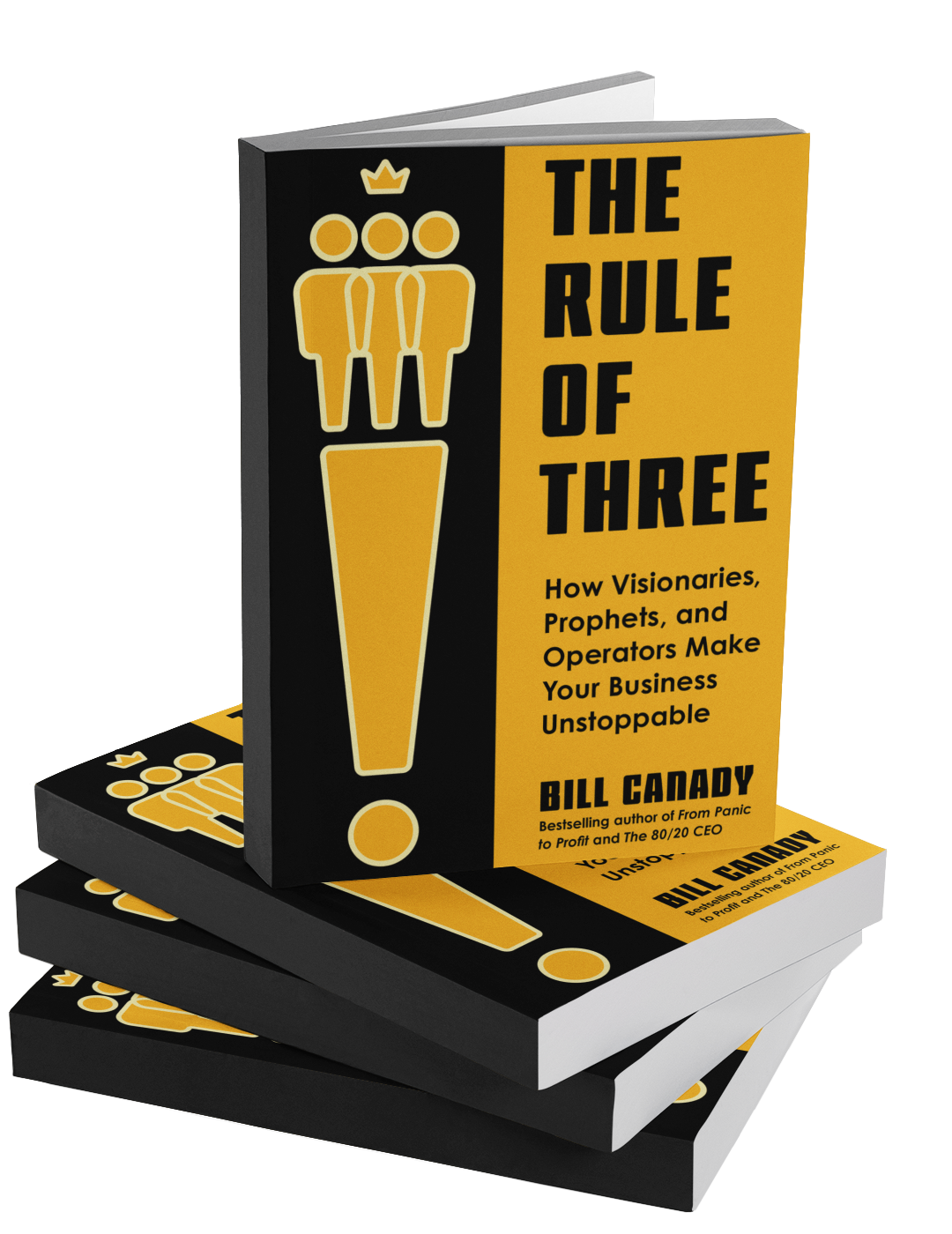
I wrote The Rule of Three because for thirty years I kept watching great strategies die in the same place — the gap between the offsite and the P&L — and the same role was missing from the leadership team every single time. That is the answer to the title, and the book exists because I finally got tired of explaining the pattern one whiteboard at a time. Today I am Chairman and CEO of a $1.5 billion PE-backed industrial company and chairman of another business approaching a billion, and across three decades of operating, chairing, and acquiring, the pattern has held with almost embarrassing consistency: the vision was usually fine, the execution muscle was usually real, and the translation between them belonged to nobody. This post is the story of the pattern, the week I finally named it, and — since a book is a tool and tools have intended users — an honest account of who The Rule of Three is for and what it will actually do for them.
The Pattern I Couldn’t Unsee
It starts with a scene every executive has lived. A leadership team comes back from the strategy offsite with genuine conviction. The deck is good. The market call is defensible, sometimes brilliant. Everyone agrees on the destination. And then, over the following four quarters, nothing about the P&L changes shape. The budget is last year plus six percent. The operating reviews review operations, not the strategy. By the next offsite, the team is refining a vision that the company’s actual arithmetic has never met. I watched this movie as a young operator and assumed it was an execution problem. I watched it as a CEO and assumed it was a communication problem. It took me an embarrassing number of years — and seats on both sides of the board table — to see that it was a structural problem: a specific kind of work that no role on the org chart owned. The strategy was not failing in execution. It was dying in translation, unwitnessed, between two groups of competent people who each believed the other had it.
The Week I Named It
The moment the framework crystallized was a board week a few years ago. I was chairing or advising three companies at the time — an industrial distributor around $200 million, a components manufacturer around $400 million, and a services business closing in on $700 million. Different industries, different sponsors, different problems on the surface. In the same week, all three boards had what I slowly realized was the identical conversation. Company one: visionary founder, strong plant leadership, three straight missed plans nobody could explain. Company two: superb operations, a hungry new CEO with a real market thesis, and a budget that had no relationship to the thesis. Company three: strategy deck praised by everyone including me, and a year-one plan that was, on inspection, last year’s plan with the numbers inflated. Three companies, one disease. Each had someone who could see the market. Each had someone who could run the machine. None had anyone whose job was to turn the first thing into instructions for the second. I drew three circles on a legal pad in an airport that Friday — the seer, the translator, the runner — and the book started there.
Visionary, Prophet, Operator
The framework itself is short enough to state in a paragraph, and I will, because a framework you cannot state in a paragraph is a consulting product, not a tool. Every leadership team that grows on purpose has three roles filled. The Visionary sees where the market is going and commits the company to a position before the evidence is comfortable. The Operator turns plans into what the company actually does on Tuesday — the cadence, the countermeasures, the shipped orders. And between them sits the Prophet: the person who translates the vision into a numbered plan — which customers, what price, what mix, what cost, what EBITDA, by which quarter, owned by whom. One person can genuinely hold two of these roles. Nobody can hold three, because the calendars are incompatible. And in roughly four teams out of five, the empty chair is the Prophet’s — the epidemic gap, because sales grows Visionaries and operations grows Operators and nothing in a normal career grows translators. That vacancy is where the strategies die.
Each vacancy has a signature you can read from the outside, which is what makes the framework a diagnostic rather than a taxonomy. Miss the Visionary and the company optimizes yesterday — margins hold, cadence hums, and the whole enterprise drifts toward a market that is quietly leaving. Miss the Operator and the company has brilliant meetings and nothing ships; the same red items reappear each quarter wearing fresh excuses. Miss the Prophet and you get the most common signature of all: energy at the top, competence at the bottom, and a plan that misses again while everyone works flat out and blames each other politely. When a board tells me the team is strong but the numbers never move, I have stopped listening for effort. I start looking for the empty chair, and I have learned to find it before lunch.
Who It’s For: The Visionary CEO Stuck in the Middle
The first reader I wrote it for is the founder or visionary CEO who is drowning in the middle of their own company. You can see the market — that has never been your problem. You have good people running the day to day. And yet every quarter you personally end up doing the numbering: building the plan, connecting the strategy to the budget, translating your own vision because nobody else can. You experience this as a work ethic problem or a talent problem — I just need better people. The book’s message to you is that it is a structure problem with a name. You are covering the Prophet chair at night, badly, on top of your actual job, and the fatigue you feel is the specific fatigue of doing a role no one acknowledges exists. Naming it changes everything: it turns an endless private burden into a hiring spec.
Who It’s For: The Sponsor Watching a Team Underdeliver
The second reader is the private equity sponsor staring at a portfolio company that should be working and is not. You diligenced the team. The CEO interviewed brilliantly. The ops leadership is real. And the company has now missed the plan for the third time with explanations that keep changing shape. Before you make the change that roughly seventy percent of sponsor boards end up making — usually in months eighteen through twenty-four — the book gives you a cheaper diagnostic to run first. Most of those replaced CEOs were hired as Operators or Visionaries and then silently expected to be all three roles at once. The vacancy was never named, so the person paid for it. Sometimes the CEO does have to change. But I have watched boards fire the wrong chair enough times to want the diagnosis to precede the surgery, and management diligence that asks only “is this person good?” without asking “which of the three roles does this team actually cover?” is diligence with one eye closed.
Who It’s For: The Operator Wondering Why Plans Arrive Half-Baked
The third reader is the operator — the COO, the division president, the plant-bred GM — who keeps being handed plans that dissolve on contact with reality. You hit the numbers you are given, and it never seems to add up to what the top of the house wanted, and the strategy that gets announced each January has no visible connection to the machine you run. You have probably concluded that strategy itself is theater. It is not — you have just spent your career downstream of an empty Prophet chair, executing budgets that were never actually derived from the strategy everyone applauded. The book will show you the missing step, and more usefully, it may show you your own next seat: some of the best Prophets I have ever installed were operators who turned out to have the translation gift and had simply never been given the chair.
There is a fourth reader I did not plan for and keep hearing from: the executive one level down who suspects they might be a Prophet. The finance leader who keeps getting pulled into strategy sessions because they are the only one who can make the numbers and the narrative agree. The corporate development person whose deal models are secretly the company’s only real plan. The chief of staff doing translation work under a title that names none of it. If that is you, the book will give you two things: a name for the work you are already doing, and the argument for why it deserves a chair, authority, and a compensation plan rather than gratitude. Some of the most consequential emails I have received about the book are from people in exactly this position who used a chapter of it to negotiate their own role into existence. That was not the book’s design. It might be its best outcome.
What’s in the Book That Isn’t in the Blog Posts
Fair question, since I have written about the framework here for free. The blog posts give you the concept. The book is the working toolset, and three parts of it exist nowhere else. First, the diagnostics: the structured assessment for scoring your own team — the questions, the scoring logic, the failure signatures of each missing role — in enough depth to run it on a real leadership team rather than nod at it. Second, the pairing playbooks: what each two-role combination looks like when it works, where each pairing predictably fails, and how a Visionary-Prophet CEO should staff differently from a Prophet-Operator. The pairings are where the practical texture lives, because almost every real executive is a pairing. Third, the org designs: where the Prophet sits, what the role is called, how it relates to the CFO and the strategy function, what the hiring spec says, what the first ninety days of an installed Prophet look like. Concept is free. Installation is the book.
What Readers Actually Do With It
A book like this earns its shelf space by what happens after the last page, and by now I have watched enough readers to know the three moves they make. The audit: leadership teams run the diagnostic together — often at an offsite, occasionally with knives out — and name their vacancy in a working session. The hire: the vacancy becomes a search spec written around a role instead of the usual laminated adjectives, which changes both who applies and who wins. And the role trade: my favorite outcome, where no hire happens at all — the team realizes the roles are present but sitting in the wrong chairs, and a CEO who has been failing as a Visionary hands that work to the founder on the board and becomes the excellent Prophet-Operator they actually are. The book’s job is not to make you admire the framework. It is to force one of those three moves before your next planning cycle.
- The audit. Run the diagnostic on your actual team and name the vacancy out loud. Most teams have never had the conversation because the missing role has no name in the org chart.
- The hire. Write the next executive search around the missing role by name — and test candidates by making them do the role’s work live, not describe it.
- The role trade. Sometimes the roles exist but sit in the wrong chairs. Re-dealing the same people against the three roles is free, and I have watched it transform companies in a quarter.
A word on how to run the audit without wrecking a Tuesday. Do not open by asking your team which role each person plays — everyone claims Visionary, the way everyone claims to be a strategic thinker, and the meeting collapses into flattery. Open with the evidence instead. Put three artifacts on the table: the current strategy document, the current operating plan, and the page that connects them. If the third artifact does not exist — and in most companies it does not — the vacancy has just introduced itself, impersonally, with no one accused of anything. Then work backward from the last three missed plans and classify each miss: a market call that was wrong, a translation that never happened, or an execution that failed. The classification argument that follows is the most productive fight most leadership teams will have all year, and the book referees it chapter by chapter.
The Letter That Told Me the Book Worked
Months after publication, I got a letter — an actual letter — from the CEO of a family-owned industrial company in the Midwest, doing around $150 million. He had read the book, run the audit with his team, and discovered what he described as the most expensive vacancy he had never seen: he was the Visionary, his brother ran operations superbly, and for nineteen years the Prophet chair had been empty while the two of them argued about whose fault the missed plans were. They did not hire anyone. They promoted a quiet finance director who, given the chair and the authority, produced the company’s first real bridge in two decades. The line I keep is this one: for nineteen years I thought my brother was the problem, and my brother thought I was, and the book cost twenty-eight dollars. I have been paid a great deal more for advice that accomplished a great deal less. That letter is framed in my office, and it is the answer I now give when someone asks why a sitting CEO bothers writing books.
Where It Fits With the Other Two Books
The Rule of Three is the third book in what turned out — unplanned — to be a system. From Panic to Profit is the turnaround book: what to do when the business is in real trouble and the first job is stabilizing cash, facts, and focus. The 80/20 CEO is the focus system: the operating playbook for concentrating a company on the customers, products, and actions that actually produce profit, and running it on a cadence. The Rule of Three is the team book: who has to be sitting in which chairs for either of the other two systems to run without you personally holding every gear. The sequence matters — panic first if you are in one, focus second, team third — but readers enter wherever it hurts. If your plans are good and your team keeps failing to land them, start with The Rule of Three. All three live on the Books page if you want the map.
Read It, Then Run the Diagnostic
So: order The Rule of Three — the Books page has the links, or get it wherever you buy books. Read it with your actual team in mind, not in the abstract; the framework only pays when it has names in it. And then do the thing the book was built for: take the free Rule of Three Diagnostic. Fifteen minutes, a handful of blunt questions, and it will tell you which of the three roles your team is missing and what the vacancy is likely costing you. I wrote the book because I could not unsee the pattern. The diagnostic exists so you cannot either. Fair warning from thirty years of running this play: once you see your empty chair, you will not be able to stop seeing it — and that discomfort, in my experience, is worth more than most strategy budgets.
Frequently Asked Questions
What Is The Rule of Three Book About?
The Rule of Three argues that every leadership team needs three roles filled to grow on purpose: a Visionary who calls where the market is going, a Prophet who translates that vision into a numbered financial plan, and an Operator who converts the plan into weekly execution. Most teams have two of the three, and the missing role — usually the Prophet — is where great strategies die between the offsite and the P&L.
Who Should Read The Rule of Three?
Three readers in particular: the visionary CEO or founder personally covering the translation work at night and mistaking a structure problem for a talent problem, the private equity sponsor watching a diligenced, talented team miss plan repeatedly, and the operator who keeps receiving half-baked plans and has concluded that strategy is theater. Each is living a different symptom of the same vacancy.
What Is in the Book That Is Not in the Free Blog Posts?
The installation toolset: full team diagnostics with scoring logic and the failure signatures of each missing role, pairing playbooks for every two-role combination and how each should staff its gap, and the org designs — where the Prophet sits, the hiring spec, the relationship to the CFO, and the first ninety days of the role. The blog gives the concept; the book is built for running it on a real team.
How Does The Rule of Three Relate to Bill Canady’s Other Books?
They form a sequence. From Panic to Profit is the turnaround book for stabilizing a business in trouble. The 80/20 CEO is the focus system for concentrating on the customers and products that produce profit and running the plan on a cadence. The Rule of Three is the team book — who must sit in which chairs for the other two systems to work. Start wherever it hurts; details are on the Books page.
How Do I Find Out Which of the Three Roles My Team Is Missing?
Take the free Rule of Three Diagnostic — about fifteen minutes of blunt questions that score your team against the three roles and tell you which chair is empty and what it is likely costing you. In practice, roughly four teams out of five discover the vacancy is the Prophet: nobody owns turning the strategy into a numbered plan with owners and dates.