
80/20 Principle: How I Apply It to Leadership and Faith
by Bill Canady in Podcast
April 9, 2026
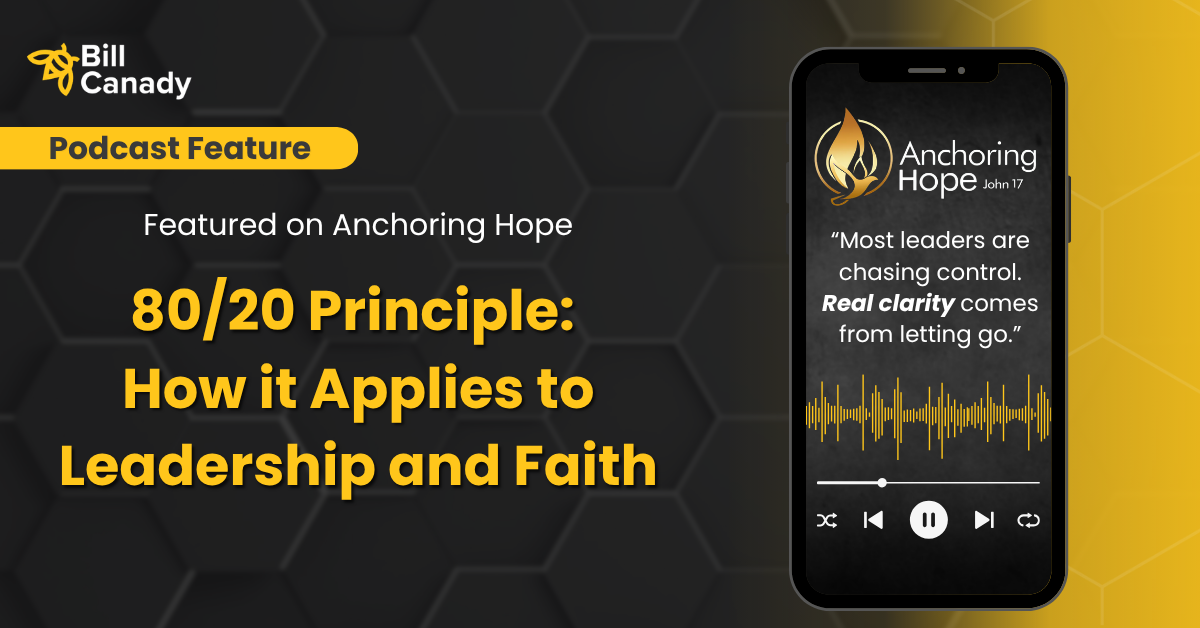
I recently had the opportunity to join Anchoring Hope for a conversation that went deeper than business strategy.
We talked about something I believe is just as important as execution, discipline, and growth.
We talked about alignment.
Because after decades of leading companies, scaling organizations, and navigating crisis, I’ve learned this:
If your priorities are off, everything else will be off too.
That’s where the 80/20 principle comes in.
The 80/20 Principle Is Not Just Business — It’s Life
Most people think of the 80/20 principle as a business tool.
20% of your efforts drive 80% of your results.
That’s true.
But I don’t just apply it to business. I apply it to how I live, how I lead, and how I make decisions.
Because the real question isn’t:
Are you busy?
It’s:
Are you focused on what actually matters?
Where Leaders Get It Wrong
I see this all the time.
Leaders try to do everything.
They chase every opportunity.
They respond to every problem.
They spread their time across too many priorities.
And then they wonder why results don’t follow.
Here’s the truth:
You don’t get rewarded for doing more.
You get rewarded for doing what matters most.
Faith, Focus, and Clarity
One of the most important parts of the conversation on Anchoring Hope was this:
You have to know what anchors you.
For me, that starts with faith.
Because faith creates clarity.
And clarity allows you to apply the 80/20 principle at a deeper level.
It helps you answer questions like:
- What actually matters in the long run?
- What am I building toward?
- Where should I invest my time, energy, and leadership?
Without that foundation, the 80/20 principle becomes just another productivity tool.
With it, it becomes a decision-making system.
How I Apply 80/20 in Business
When I step into a company, I’m not trying to fix everything.
I’m trying to find the critical few.
The 20% that actually drives results.
That usually comes down to:
- The right customers
- The right products
- The right people
- The right decisions
Everything else is noise, distraction, or inefficiency.
And once you see that clearly, the job becomes simple:
Do more of what works.
Stop doing what doesn’t.
The Discipline Most People Avoid
Here’s the part people don’t like.
80/20 requires elimination.
You can’t just add more of the good stuff.
You have to remove the things that don’t matter.
That might mean:
- Walking away from customers
- Simplifying your product line
- Saying no to opportunities
- Reallocating resources
That’s not easy.
But it’s necessary.
Because growth doesn’t come from adding complexity.
It comes from removing it.
Leadership Is About Focus
At the end of the day, leadership is not about knowing everything.
It’s about focusing on the right things.
I’ve always said:
Leadership is figuring it out and getting it done.
The 80/20 principle helps you figure out:
- What matters
- What doesn’t
- Where to act
- Where to stop
And once you have that clarity, execution becomes a lot easier.
The Connection Between Faith and Execution
What stood out to me in this conversation is how closely faith and execution are connected.
Faith gives you:
- Confidence in uncertainty
- Direction when things are unclear
- Stability when everything feels chaotic
And that’s exactly what leaders need.
Because business is never predictable.
Markets shift.
Conditions change.
Challenges show up.
The leaders who succeed are the ones who stay grounded and focused.
Final Thought
If there’s one thing I would leave you with, it’s this:
You don’t need to do more.
You need to do what matters.
Focus on the 20% that drives your results.
Align your actions with your values.
And have the discipline to follow through.
That’s how you move from noise to clarity.
That’s how you lead with purpose.
And that’s how you build something that lasts.
Opening Conversation
Host:
Bill, welcome to the show.
Bill Canady:
It’s great to be here. I appreciate you having me.
Host:
One of the first things I noticed is your book From Panic to Profit. That really speaks to something a lot of people feel—especially men.
We feel responsible for providing, for carrying everything. And when you’re running a business, that pressure is even more intense.
Bill Canady:
That’s exactly right.
The idea of “panic to profit” is really a metaphor for life. A lot of people feel like they carry the weight of the entire world.
The question becomes: how do you find your way through that? What does that actually look like?
What Bill Does
Host:
So what do you do today?
Bill Canady:
I do a few different things.
I’ve written several books, but my main work is helping companies find a path to profitable growth.
When you come into a business as a leader—day one—usually something isn’t going right. There’s some level of chaos or panic.
And what I do is help bring structure, clarity, and direction.
That’s what the book is about. It gives leaders a roadmap to move from chaos to control.
Learning Through Failure
Host:
How did you develop this knowledge?
Bill Canady:
Honestly, I failed a lot.
You try things. Some work, some don’t.
The things that work—you do more of.
The things that don’t—you stop doing.
I’ve also been very fortunate to surround myself with great people—great teams, great partners.
And over time, you develop a process—a methodical way of thinking through problems and executing.
The 80/20 Principle
Host:
The 80/20 rule changed my life when I discovered it. Can you explain it?
Bill Canady:
Absolutely.
It’s called the Pareto Principle.
A couple hundred years ago, Vilfredo Pareto observed that a small percentage of inputs drives the majority of outputs.
For example:
- 20% of people owned 80% of the land
- 20% of pea pods produced 80% of the crop
This pattern shows up everywhere.
In business, it means:
A small percentage of customers, products, or activities drive most of your results.
Applying 80/20 in Business
Bill Canady:
What we do is apply that principle directly to business.
We identify what’s working—the 20% that generates results.
We use data to prove it.
Then we ask:
How do we shift resources—people, time, capital—into those areas?
That’s where the growth comes from.
Do more of what works.
Do less of what doesn’t.
Why It’s Hard to Apply
Host:
It sounds simple, but it’s hard to change behavior.
Bill Canady:
It is.
Because people resist change.
Even though this principle is everywhere, we fight it.
We want to do what we feel like doing—not what actually works.
But the reality is:
Most of what we do doesn’t matter.
Only a small portion actually drives results.
Real-Life Examples
Bill Canady:
You see this everywhere.
For example, in traffic:
80% of traffic is on 20% of the roads.
In life:
I have a closet full of clothes, but I wear the same few outfits all the time.
The principle is universal.
The challenge is applying it.
Faith and Focus
Host:
I believe this connects deeply to faith.
We’re meant to be free—but many people become slaves to their business.
Bill Canady:
That’s exactly right.
People focus on things that don’t matter.
Instead of spending time on:
- family
- faith
- meaningful work
They get distracted.
And over time, that has consequences.
You lose relationships.
You lose clarity.
Your business suffers too.
A Real Transformation Story
Host:
I went through that myself.
I was working 14–15 hours a day for years.
Eventually, I had a serious health issue.
That forced me to rethink everything.
I applied the 80/20 principle:
- I fired 80% of my clients
- Let go of 80% of my team
- Focused on the 20% that actually drove results
And everything changed.
I went from working 15 hours a day to maybe 15–20 hours a week.
Bill’s Perspective
Bill Canady:
That’s a perfect example.
When you focus on what matters, everything becomes simpler.
Most people think success comes from doing more.
It doesn’t.
It comes from doing the right things.
Key Takeaway
Bill Canady:
The 80/20 principle isn’t just about business.
It’s about life.
It helps you focus on:
- what matters
- what drives results
- what actually moves you forward
And once you apply it, everything changes.
Closing Thought
Host:
This has been incredibly powerful.
Thank you for sharing your perspective.
Bill Canady:
Thank you. I appreciate the conversation.
