The turnaround sequence I have used for thirty years is five steps in a fixed order: visibility first, focus second, price third, mix fourth, cost last. That order is not a preference. It is the difference between companies that recover and companies that shrink themselves to death. I have run this sequence as a CEO of businesses from $50M to $1.5B, and I wrote From Panic to Profit because I kept watching smart leaders run the steps backwards — cutting first, seeing last — and wondering why the patient kept getting sicker.
What Panic Actually Is
Panic in a business has a precise clinical definition, and it is not fear. Panic is managing outcomes without seeing drivers. The P&L says EBITDA is down 30%, and that is all anyone knows. Which customers? Which products? Which price moves, which mix shifts, which cost creep? Nobody can say. So leadership manages the only thing visible — the outcome — and the only levers that seem connected to an outcome are the blunt ones.
I can diagnose the panic state in one meeting. I ask a simple question: name your ten most profitable customers, in order. Not largest — most profitable. In a healthy company the CEO answers in thirty seconds. In a panicked company I get revenue rankings, then a debate about allocations, then someone offers to get back to me. That gap — between what the business earns and what its leaders can see — is the disease. Everything else is symptom.
Panic also has a sound, and once you have heard it you never miss it again. It is the sound of meetings multiplying. The weekly ops review becomes daily. A war room appears. Everyone is exhausted and nobody can tell you what changed since yesterday, because the meetings are all about the outcome — the number, the number, the number — and the number is a lagging indicator of decisions made months ago. Activity replaces insight. I have walked into companies holding fourteen standing meetings a week about a problem no meeting had ever actually located.
Why Panic Produces Exactly the Wrong Moves
The tragedy of panic is that it is not random. It reliably produces three specific moves, and all three are wrong in the same direction: they injure the vital few — the 20% of customers, products, and people producing 80% of the profit — to protect the trivial many.
Move One: The Across-the-Board Cut
Ten percent off every budget feels fair and decisive. But your best product line and your worst product line just took the same haircut, which means you defunded your profit engine to subsidize your losses. Fair to departments, brutal to shareholders.
Move Two: The Hiring Freeze
Freezes feel free. They are the most expensive move on the list, because attrition is not evenly distributed — your best people leave first, since they are the ones with options, and the freeze guarantees you cannot replace them. I watched a company freeze its way out of its two best salespeople, who happened to cover accounts representing a third of gross profit. The freeze saved $800K of payroll and cost $4M of margin.
Move Three: Discounting to Save Volume
Revenue is falling, so leadership cuts price to defend the top line. In a typical industrial business at 30% gross margin, a 5% price cut requires roughly 20% more volume just to stand still. Nobody panicking has ever done that arithmetic before signing the discount. The volume rarely comes; the margin never comes back.
Step One: Visibility — The Data Cut
The first act of every turnaround I run is not a decision. It is a data pull. Every invoice line for the trailing twelve months: customer, product, units, price, cost. No survey, no consultant interviews, no offsite. The invoice file is the business telling you the truth about itself, and it is sitting in the ERP right now, unread.
Then the quartile cut. Rank customers by revenue and split into quartiles. Do the same for products. Cross them, and the company falls into four quadrants. The pattern is nearly universal: quartile-A customers buying quartile-A products — usually well under 10% of line items — produce something close to all the true operating profit. The bottom-right quadrant, the long tail, loses money on every order once you burden it honestly with the complexity it causes.
This step takes two to three weeks and it changes the emotional weather of the company. Panic is managing outcomes blind. The moment the drivers are visible, panic becomes impossible — you can be worried, but you cannot be lost. Every subsequent step in the sequence exists because this one happened first.
Step Two: Focus — 80/20 the Whole Company
Visibility tells you where the profit lives. Focus is the decision to act like it. That means naming the vital few out loud: these forty customers, these two hundred SKUs, these dozen people are the business. Everything else is either a development project or a tax.
Focus is where leadership earns its pay, because the trivial many have defenders. Every marginal customer has a salesperson who loves them. Every dying product has an engineer who designed it. The 80/20 cut gives you the data to have those arguments honestly — not whether we like this customer, but whether we can afford them. Protecting the vital few is the entire strategy in a turnaround. Whatever survives the crisis must include them, or there is nothing left worth saving.
Focus is also physical, not just analytical. Once the vital few are named, they get the best of everything: the best salespeople reassigned to the A accounts, the best plant capacity reserved for the A products, the CEO’s own calendar loaded with A-customer visits. In a turnaround I personally call the top twenty customers in the first month — not to sell, but to ask what we have been getting wrong. Two of those calls have saved accounts that were quietly halfway out the door, and neither defection had appeared in any pipeline report. The vital few will forgive a company in trouble. They will not forgive being ignored by one.
Step Three: Price — The Fastest Dollar in Business
Price comes before cost for a simple reason: a dollar of price falls to EBITDA at nearly 100%, requires no restructuring charge, and can be executed in weeks. And in every distressed company I have ever opened up, the data cut reveals the same buried treasure — wild, unmanaged price dispersion. The same SKU selling to same-sized customers at prices 25% apart, for no reason anyone can defend. That dispersion is not a market condition. It is decades of unmanaged exceptions.
Turnaround pricing is surgical, not general. You do not announce 8% across the board — that is the panic version, in reverse. You lift the below-band accounts to the band. You attach charges to the tail: minimum orders, expedite fees, freight recovery. The vital-few accounts, the ones you named in step two, you mostly leave alone or handle personally. Done this way, price adds points of margin with astonishingly little volume loss, because the customers being repriced were being subsidized, and somewhere they know it.
The internal resistance to pricing is always louder than the market’s. Sales will predict an exodus. I have run this move enough times to publish the actual statistics: lift the bottom-band accounts to the median and you typically lose a low-single-digit percentage of them — disproportionately the ones losing you money anyway, which makes the departures a gift with a bow on it. The fastest way to convert the skeptics is a pilot: fifty accounts, one region, ninety days. When the region posts three points of margin and keeps 96% of the accounts, the argument ends itself. In a turnaround, one small proven win buys more organizational permission than any speech.
Step Four: Mix — Sell More of What Makes Money
Mix is the slow-motion lever, and the most underrated. Once you know exactly which products and customers make money, you tilt the whole commercial engine toward them. Sales comp pays on gross profit dollars, not revenue. Lead times, inventory, and service levels are guaranteed for the A quadrant and merely offered for the tail. Quoting rules steer marginal orders toward standard, profitable configurations.
The tail gets managed, not massacred. Some tail customers are quietly repriced into profitability — plenty accept, and each acceptance is found money. Some are moved to distributors. A few are exited, politely. The point is not to shrink revenue; it is to change what a dollar of revenue earns. In one business we held revenue flat for eighteen months while EBITDA nearly doubled. Nothing heroic happened. The mix just stopped fighting us.
Step Five: Cost — Last, and Finally Safe
By step five, cost cutting stops being dangerous, because now you know what everything is for. The 80/20 work has already told you which plants, which inventory, which complexity, and which overhead exist only to serve the unprofitable tail. Cutting that is not austerity — it is hygiene. The tail-ectomy in steps three and four typically strands 15-20% of operating cost that can now be removed without touching a single vital-few customer or the people who serve them.
Notice what this order buys you. The company that cuts first swings the axe blind and hits its own leg. The company that cuts last swings once, at a target painted by its own invoice data. Same axe. Entirely different surgery.
There is a cash caveat, because someone always raises it: what if the company cannot survive long enough to do this in order? Fair. If the thirteen-week cash forecast says the lights go out before the sequence pays, you do triage first — stretch payables, factor receivables, pause capex, negotiate with the lender. But triage is not turnaround, and the distinction matters. Triage buys weeks; only the sequence buys a company. And even in triage, the one thing I still refuse is the across-the-board operating cut, because it converts a cash crisis into a franchise crisis. You can recover from tight cash. You cannot recover from a gutted vital few.
The First 30 Days, Hour by Hour
People ask what the first month of a turnaround actually looks like. Week one is almost embarrassingly quiet from the outside: day one, I meet the team and make exactly one promise — no across-the-board cuts while I am in the chair. Days two through five belong to the data: the invoice pull, the cash bridge, and one-hour sit-downs with every direct report where I mostly listen. I am cataloguing who sees drivers and who only sees outcomes.
Week two is the quartile work — mornings with the analyst building the cut, afternoons walking the plant and riding along on customer visits, because the data always has a story the floor can confirm or kill. Week three, the leadership team spends two full days in a room with the quadrant map, and we name the vital few together. Naming them together matters; a list handed down is a memo, a list built together is a commitment. Week four, we act: the below-band pricing list goes out, tail charges are drafted, the first monthly bridge page is built, and each of the five levers gets an owner’s initials on it.
Day 30, the company has visibility, a named vital few, price motion in market, and a one-page plan reporting monthly. Not one job has been cut. Panic, meanwhile, has quietly left the building — panic cannot survive contact with a plan.
The Company That Was Saved by Refusing to Cut
A disguised story. Flow-control components maker, roughly $220M revenue, EBITDA down 40% in eighteen months, lender getting loud. The board’s opening position was a prepackaged 15% reduction in force — the banker had already modeled it. I asked for sixty days before any cut, and I will admit the room did not love me for it.
The data cut found the real problem in nineteen days. A push for growth two years earlier had loaded the business with quartile-D customers buying custom configurations at quartile-A prices minus a negotiated discount — every order profitable on paper, ruinous once engineering hours and expedites were burdened in. The factory was drowning in complexity that the P&L recorded as overhead absorption problems. The proposed RIF would have cut the very engineers and machinists serving the profitable core, while leaving every money-losing order in the backlog.
Instead: tail repriced with a 6-week ultimatum, 30% of it left, nobody chased them. Two hundred SKUs killed. Below-band core accounts lifted 4%. Fourteen months later EBITDA had recovered past its prior peak on 12% less revenue, and headcount was down 8% — all through attrition in areas the tail-ectomy had emptied of work. The RIF that never happened would have saved $9M of payroll and destroyed the $30M core. Refusing to cut first was the entire turnaround.
The Company Where the Panic Moves Had Already Done the Damage
The other story keeps me honest about what this sequence cannot fix. Building-products distributor, called in after two years of self-administered treatment: three across-the-board cuts, a two-year hiring freeze, and a standing 10% discount authority that sales had used on essentially every renewal. Each move had been rational in the meeting where it was decided. Together they had amputated the future.
The data cut still worked — the quadrants were where they always are. But when we went to the vital few to fix price and service, the damage surfaced. The freeze had cost them the four inside-sales veterans who actually knew the A-quadrant accounts; the discounting had taught those accounts that price was a suggestion; the budget cuts had gutted delivery reliability, which was the only reason the vital few had stayed loyal at all. Three of the top ten customers had already dual-sourced. You cannot reprice a relationship you no longer have.
We stabilized the business, but it exited two years later at roughly half the multiple the first story earned. Same playbook, same operator, radically different outcome — because sequencing is not just about what you do. It is about what is still alive when you start. Every across-the-board move you make while blind narrows what any future plan can recover. That is the real cost of panic, and it never shows up on the P&L where the savings do.
When the Turnaround Is Actually a Team Problem
One honest caveat. Sometimes the data cut and the first thirty days reveal that the business problem is downstream of a people problem. The signature is unmistakable: you present the quadrant map — the clearest picture of the business anyone has ever seen — and a senior leader argues with the invoice file. Not with the interpretation. With the arithmetic. Their business unit, their legacy product line, their favorite customer cannot be in the losing quadrant, therefore the data must be wrong.
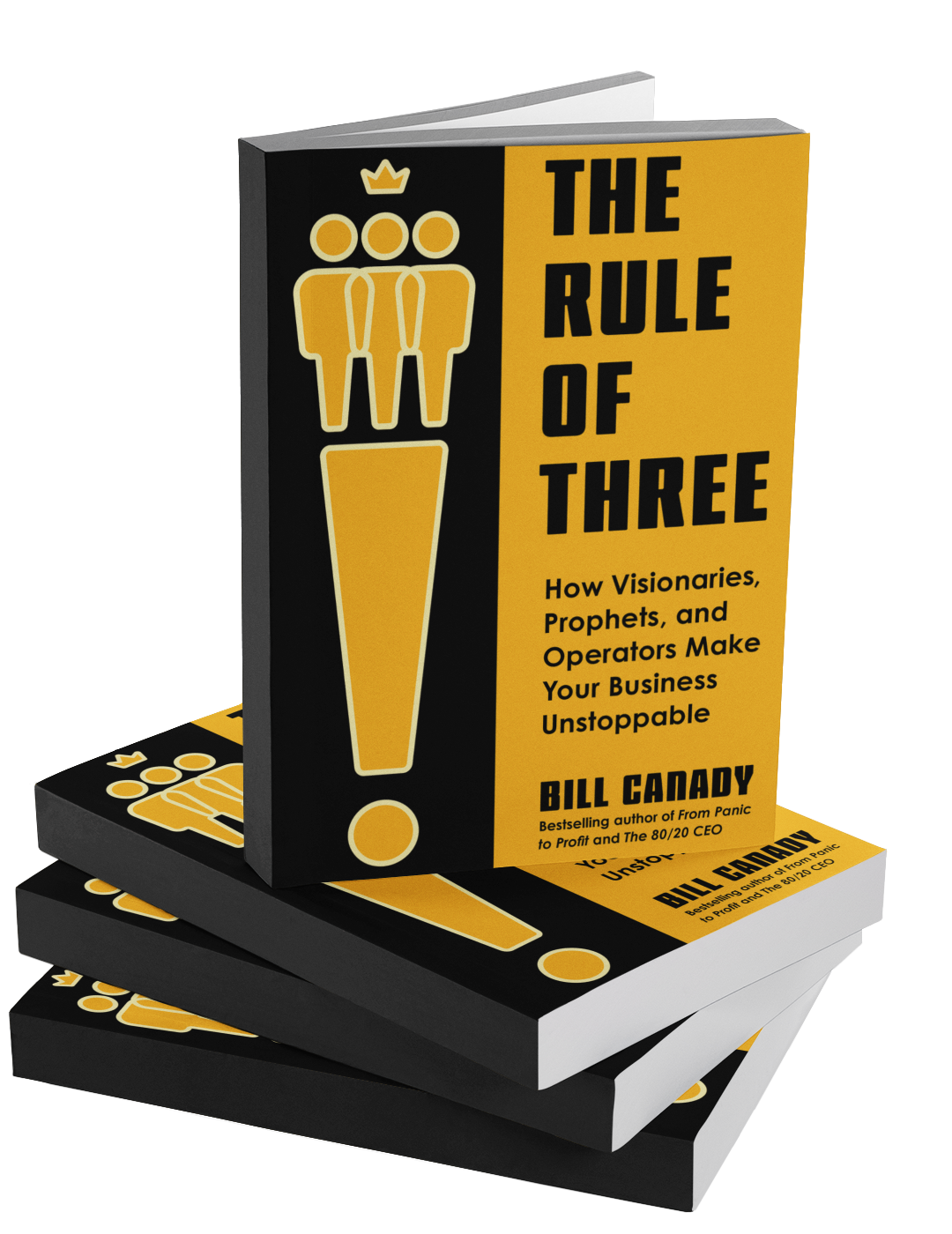
In The Rule of Three I describe the three leaders every business needs — the Visionary who sees what it could be, the Prophet who says what others will not, and the Operator who makes the trains run. A turnaround needs the Operator in the chair and the Prophet at full volume. What it cannot survive is a leadership team where the person who owns the biggest lever will not accept what the data says about their own operation. I give that conversation exactly two attempts. The sequence forgives almost every business condition. It does not forgive a leader who prefers blindness, because visibility is step one, and step one is not optional.
The Sequence Is the Book
Everything above is the skeleton of From Panic to Profit. The book walks the full sequence in order — the panic diagnosis, the data cut mechanics, the 80/20 quartile method, the pricing playbook, the mix engine, and the cost work that comes last — with the templates and the war stories at full length, including the ones that went sideways. If your business is somewhere between uncomfortable and frightening right now, read it before your next budget meeting. The most expensive week of a turnaround is the one where the panic moves get made, and it is usually the week before somebody finally pulls the invoice file.
Visibility first. Focus second. Price third. Mix fourth. Cost last. Thirty years, and I have never once regretted the order.
Frequently Asked Questions
What Is the Correct Sequence for a Business Turnaround?
Five steps in fixed order: visibility first (pull twelve months of invoice-line data and run 80/20 quartile analysis), focus second (name the vital few customers and products), price third (fix dispersion and lift below-band accounts), mix fourth (tilt the commercial engine toward profitable business), and cost last. The order matters more than the steps — cutting cost before visibility injures the profit core.
Why Is Across-the-Board Cost Cutting a Mistake in a Turnaround?
Because profit is concentrated. Roughly 20% of customers and products typically generate 80% or more of true profit, so a uniform cut defunds the profit engine at the same rate as the losses it subsidizes. Cost work is safe only after 80/20 analysis shows which costs exist solely to serve unprofitable business.
What Should Happen in the First 30 Days of a Turnaround?
Week one: promise no blind cuts, pull the invoice data, interview every direct report. Week two: build the customer and product quartile cut and validate it on the floor and in the field. Week three: name the vital few with the leadership team. Week four: launch surgical pricing, draft tail charges, and stand up a one-page EBITDA bridge with an owner on every lever. No layoffs, full visibility.
How Fast Does Pricing Work in a Distressed Company?
Fastest of any lever — weeks, not quarters. Most distressed companies carry unmanaged price dispersion of 20% or more on identical products to similar customers. Lifting below-band accounts to the band and adding tail charges (minimums, expedites, freight recovery) drops nearly straight to EBITDA with minimal volume loss, because the repriced accounts were being subsidized.
When Is a Turnaround Really a Leadership Team Problem?
When a senior leader argues with the invoice data itself rather than its interpretation — insisting their unit or favorite customers cannot be unprofitable despite the arithmetic. A turnaround survives most business conditions but not a lever owner who prefers blindness. As I frame it in The Rule of Three, the fix needs an Operator in the chair and a Prophet willing to say so out loud.