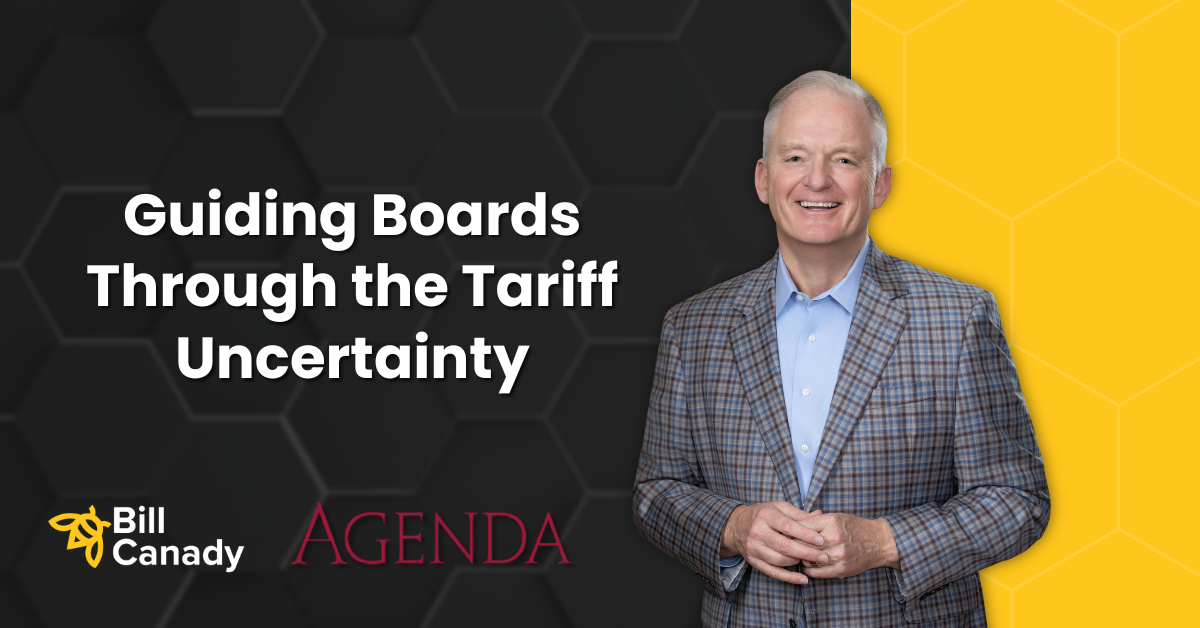
How I’m Guiding Boards Through the Tariff Uncertainty
by Bill Canady in News
March 4, 2026
Last week’s Supreme Court ruling on tariffs triggered what I would call controlled chaos in boardrooms across the country.
I’ve been on multiple board calls this week — some scheduled, some labeled “emergency.” Directors are asking the same questions:
What does this mean for us?
Do we pursue refunds?
Do we change pricing?
Do we pivot supply chains again?
My answer hasn’t changed.
When the environment gets noisy, leaders must get steady.
I Don’t React to Headlines. I Respond to Strategy.
The Court struck down the previous tariff structure. Within days, new tariffs were introduced under different authority.
That tells me something important: this isn’t over.
So I’m not advising panic. I’m advising discipline.
In my companies and in the boardrooms where I serve, my focus right now is simple:
- Hold pricing steady.
- Protect margin.
- Preserve optionality.
- Stay aligned to long-term strategy.
I’ve learned over three decades of leading through disruption — recessions, supply chain breakdowns, regulatory swings — that volatility punishes emotional decisions and rewards structured thinking.
Refunds: I Treat Them as a Capital Allocation Decision
A lot of directors are asking whether we should pursue tariff refunds.
I look at it this way: this is not just a legal question. It’s a capital allocation question.
Before I support any refund strategy, I want clear answers:
- What is our total exposure?
- What are the realistic recovery scenarios?
- What’s the administrative burden?
- If we receive funds, who benefits — shareholders or customers?
- What precedent does that set?
I don’t move based on potential headlines. I move based on modeled outcomes.
That’s how boards should operate.
My View on Pricing: Don’t Blink
Analysts immediately ask whether we’ll lower prices.
My position is straightforward: not right now.
You don’t make permanent pricing decisions based on temporary rulings.
If tariffs reappear under another legal pathway — and I believe there’s a strong possibility they will — and you’ve already reduced pricing, you’ve created unnecessary margin pressure and instability.
Consistency builds credibility.
Overreaction destroys it.
What I’m Watching Long Term
The real story here isn’t one court ruling.
It’s the broader shift in global trade.
Protectionism is rising. Supply chains are being rethought. Governments are more willing to intervene in commerce than they were a decade ago.
That means my long-term focus stays the same:
- Simplify supply chains.
- Diversify sourcing.
- Reduce concentration risk.
- Evaluate reshoring where it strengthens resilience.
If I were in the middle of relocating operations, I would stay the course.
This is not a short-term cycle. It’s a structural shift.
Every Business I Lead Has a Tariff Playbook
If you’re running a business in 2026 without a tariff playbook, you’re operating without preparation.
I expect management teams to have:
- Scenario models.
- Defined pricing triggers.
- Contingency sourcing plans.
- Clear investor messaging.
- Refund strategy frameworks.
Preparation turns uncertainty into manageable risk.
What we were doing six months ago — disciplined pricing, operational alignment, cost offsets — is exactly what we’re doing today.
That’s not stubbornness. That’s consistency.
My Leadership Philosophy in Moments Like This
I’ve always said leadership is about figuring it out and getting it done.
That doesn’t change when policy shifts.
When uncertainty rises, I focus on three things:
- Stay calm.
- Stay disciplined.
- Stay aligned to strategy.
Boards don’t get paid to chase headlines.
They get paid to protect and grow long-term value.
Uncertainty is part of leadership. Always has been.
My job isn’t to eliminate volatility.
My job is to lead through it.
And that starts with discipline.
