
In 80/20 analysis, A customers get to be A customers because they buy A products. Conversely, A products get to be A products because your best customers (A customers) buy them. Nevertheless, some, maybe even many, of your A customers also buy—out of desire or necessity—some of your B products.
Obviously, it is important to know what B products your A customers buy. You need to satisfy your A customers. If you don’t, they will find somebody else who will. Supplying A customers with their desired B products is therefore a necessity. In fact, many 80/20 gurus call it a “Necessary Evil,” because the intersection of A customers and B products is often a break-even proposition. You don’t lose money selling to Quad 2, but—often—it fails to be a profit center.
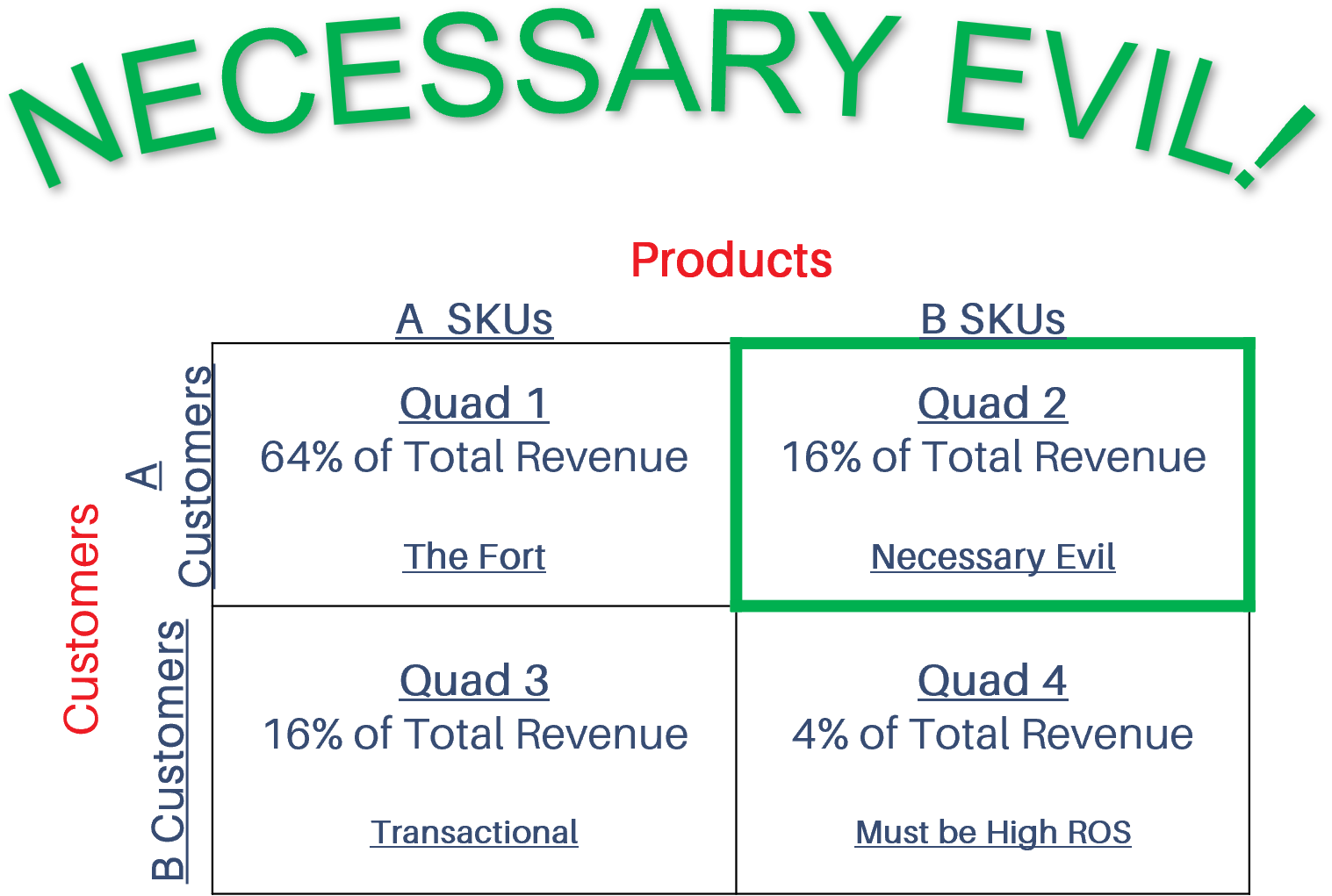
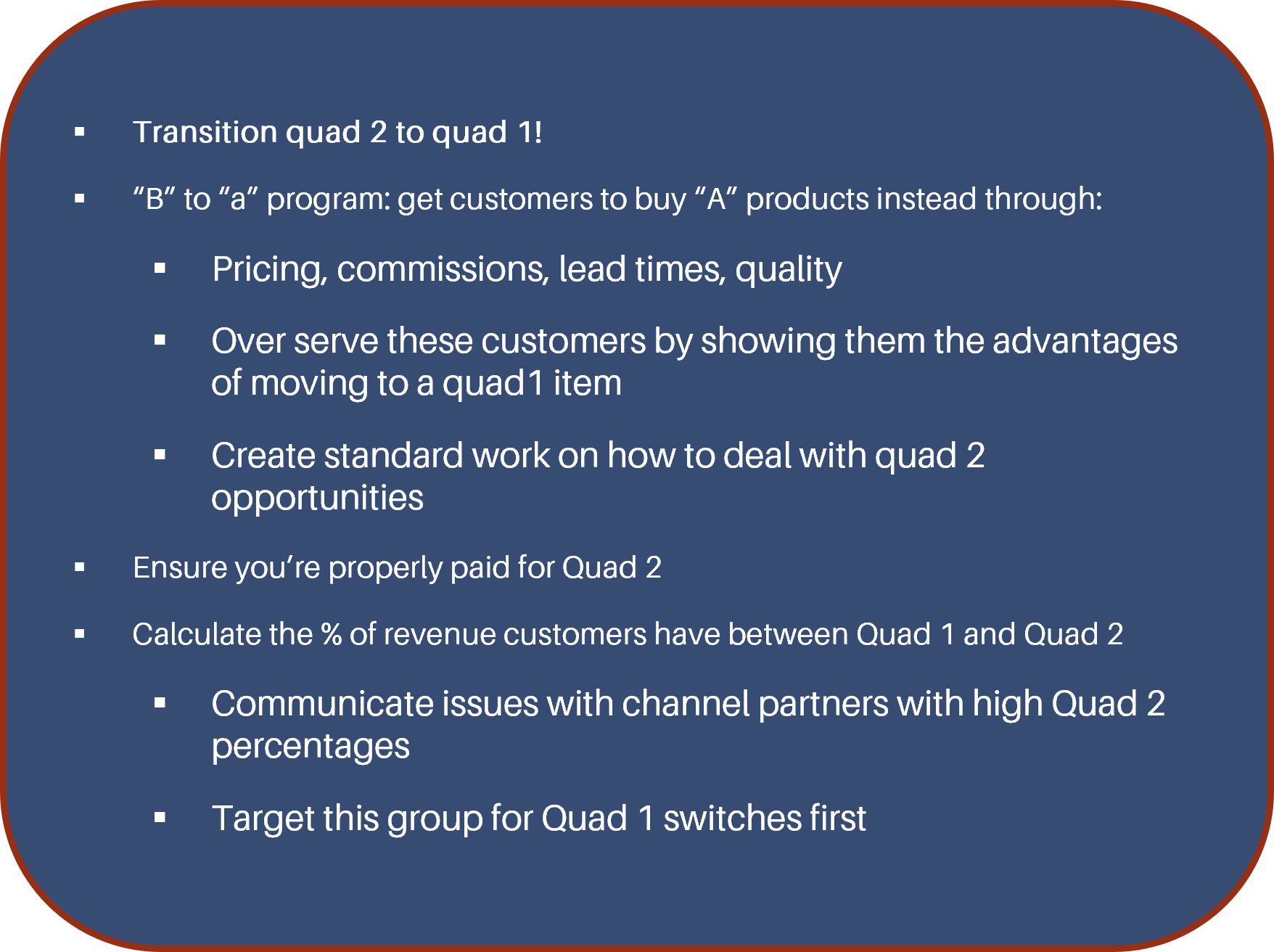
It is important that you make A customers happy customers. You want to hold on to them, whether they are in the Fort (Quad 1) buying A products or in the “Necessary Evil” bin, Quad 2, buying certain B products. But you should draw the line at losing money. This does not mean that you need to shrink Quad 2 into nothing. Nor does it mean that you should allow yourself to lose “just a little money.” A much better strategy is to convert the “Necessary Evil” into a Desirable Necessity.
Just as you don’t want to give up on a B customer because he or she happens to fall into the top 21 percent or 25 percent or 35 percent but not the top 20 percent, neither do you want to reflexively jettison a B product that straddles the line between profit and loss. If you can convert a B customer into an A customer, you have won an important victory. If you can figure out a way to sell a lower-performing B product to more customers and thus promote it to an A product, do so. Just beware of investing more resources than it is worth. Remember, a resource—whether it is advertising, a sale price, or an A-level sales professional—who focuses on a B product becomes unavailable or at least less available for your top-performing products and customers. It is worth cultivating and curating promising B products by making them more appealing to A customers, provided you can do this without endangering the Fort—Quad 1.