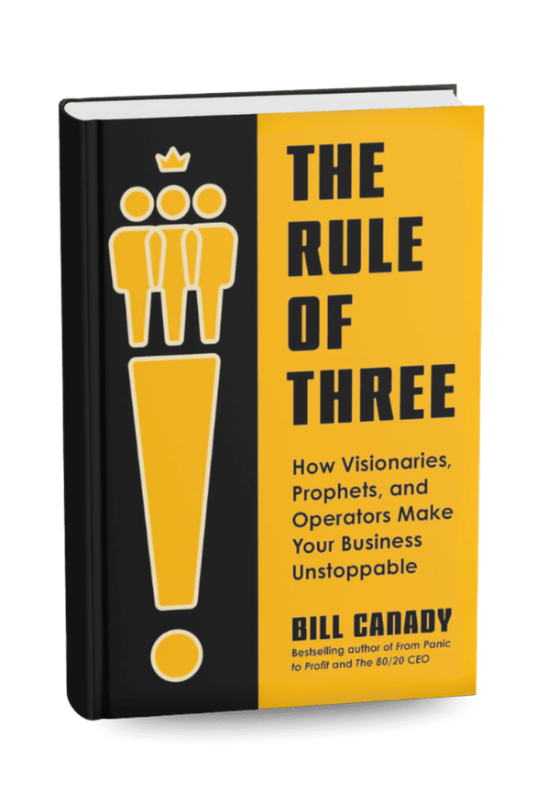
The Rule of Three: A Framework for Scalable Leadership
Discover 'The Rule of Three,' a revolutionary book by Bill Canady designed to empower leaders and transform business operations. This framework addresses the common challenge of CEO dependency, offering a structured approach to building effective leadership teams that drive growth and efficiency.
The book introduces three core leadership roles – Visionaries, Prophets, and Operators – essential for moving beyond bottlenecked decision-making. By implementing this system, leaders can foster a more agile and accountable organization, ensuring strategic execution and sustainable momentum.
Understanding the Three Core Leadership Roles
At the heart of 'The Rule of Three' lies a clear delineation of essential leadership functions. These roles are designed to create a balanced and robust leadership structure, ensuring all critical aspects of business operations are covered without placing an undue burden on any single individual.
The Visionary role focuses on setting the long-term direction and strategic intent. The Prophet role is dedicated to developing people, strengthening culture, and fostering growth within the team. Finally, the Operator role is responsible for translating strategy into tangible execution through alignment of people, priorities, processes, and performance.
Implementing Leadership Rhythm for Consistent Performance
Beyond defining roles, 'The Rule of Three' emphasizes the creation of a 'leadership rhythm' – a consistent cadence of meetings, communication, and accountability mechanisms. This rhythm ensures that teams remain aligned, informed, and actively engaged in achieving business objectives.
Establishing this rhythm involves implementing specific tools, scorecards, and communication habits. This structured approach prevents strategic drift, enhances collaboration, and ensures that day-to-day operations consistently support the overarching vision, leading to predictable and profitable growth.
Achieving Execution Discipline for Measurable Results
A critical component of 'The Rule of Three' framework is fostering 'Execution Discipline.' This concept moves beyond mere intention and planning to focus on concrete ownership, decisive action, rigorous follow-through, and the tracking of measurable business results.
This discipline ensures that strategic initiatives are not left as abstract ideas but are systematically translated into actionable steps with clear accountability. By embedding this into the organizational culture, businesses can achieve a higher rate of success in their strategic endeavors and drive demonstrable, on-demand profitable growth.
Reducing CEO Dependency for Sustainable Growth
One of the primary benefits of adopting 'The Rule of Three' framework is the significant reduction of dependency on the CEO. This allows the CEO to focus on higher-level strategic thinking and innovation, rather than being constantly pulled into operational details and day-to-day decision-making.
By empowering the Visionary, Prophet, and Operator roles, businesses create a distributed leadership model. This not only builds capacity within the organization but also ensures business continuity and resilience, making the company less vulnerable to the absence or overload of its central leader.